AI-Assisted Course Design
A scalable, AI-integrated production workflow for higher education courseware — maintaining pedagogical integrity, accessibility, and Cengage brand consistency at scale.
Higher education courseware production is one of the most process-heavy disciplines in publishing. Writing, instructional design, visual production, accessibility review, and platform-specific formatting — each step typically runs through a separate team, a separate tool, and a separate handoff. The result: time-intensive workflows that resist iteration and scale poorly against mounting content demands.
Time-intensive workflows across writing, design, and production slowed iteration and made rapid experimentation difficult.
Inconsistent quality across contributors and formats — no shared production baseline existed.
Limited scalability for interactive, AI-assisted, and visual content types within existing production pipelines.
Traditional publishing processes were not optimized for rapid iteration or AI-assisted experimentation at scale.
The work required a clear mandate: integrate AI into the courseware production workflow in a way that accelerated output without degrading the quality signals that make educational content work.
Use AI to accelerate content creation without sacrificing quality or pedagogical integrity.
Produce modular, reusable lesson components for scalable delivery within MindTap.
Maintain instructional and visual consistency across all contributors and content types at scale.
Integrate Cengage's GenAI Student Assistant into the lesson flow without disrupting established learning patterns.
A repeatable system that transforms raw curriculum into production-ready MindTap lesson experiences — with clear handoffs between AI generation and human refinement.
The production system was designed as a linear pipeline with clear handoff criteria between each phase. AI tools were introduced at specific, auditable stages — never as a wholesale replacement for human judgment, but as a force multiplier at the points where speed matters most.
Interactive walkthrough of the full pipeline — from curriculum input through AI content generation, modular structuring, governance, and MindTap delivery. Includes phase-by-phase breakdown with governance checkpoints.
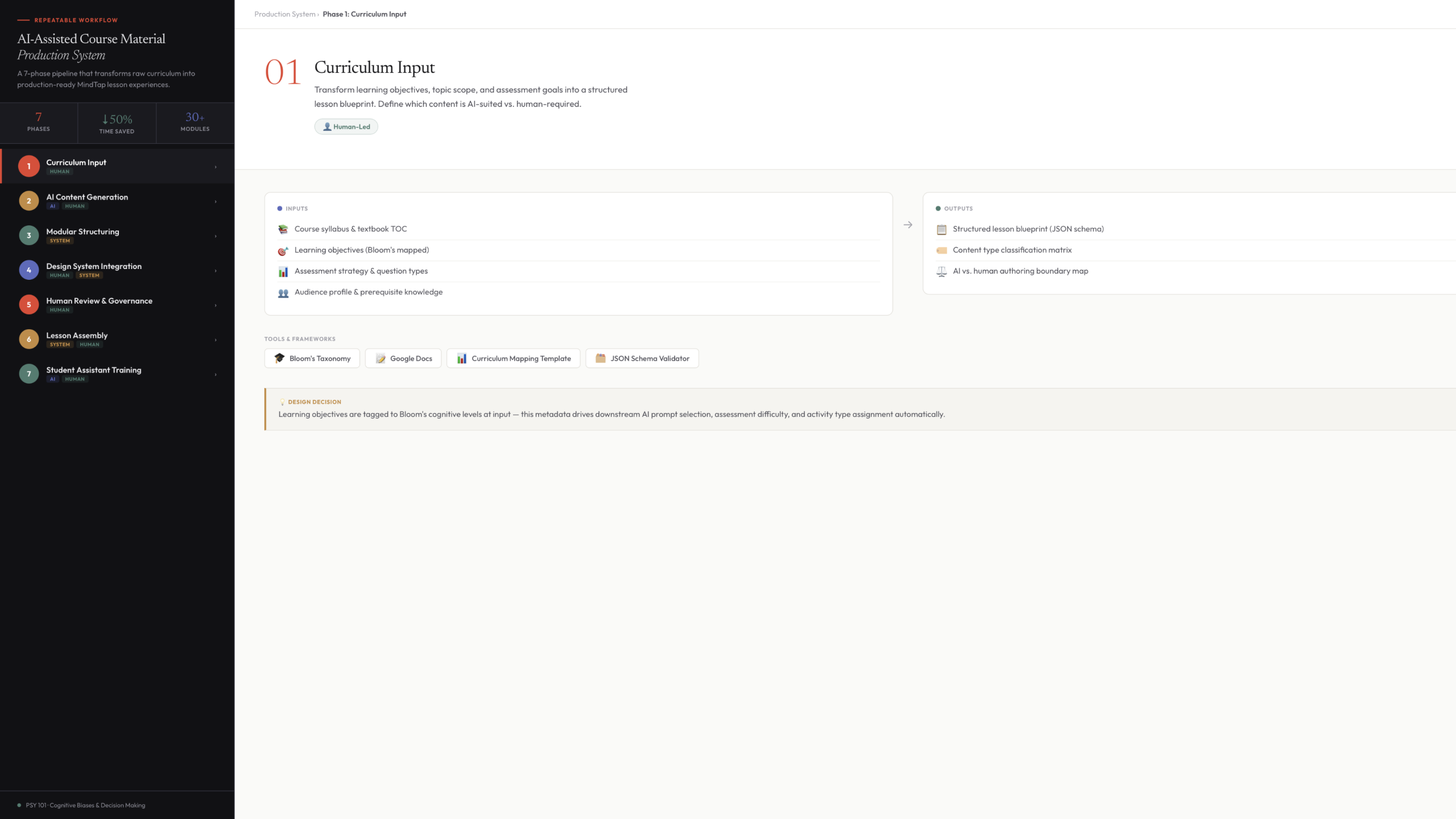
Production pipeline overview — from curriculum intake to MindTap-ready delivery.
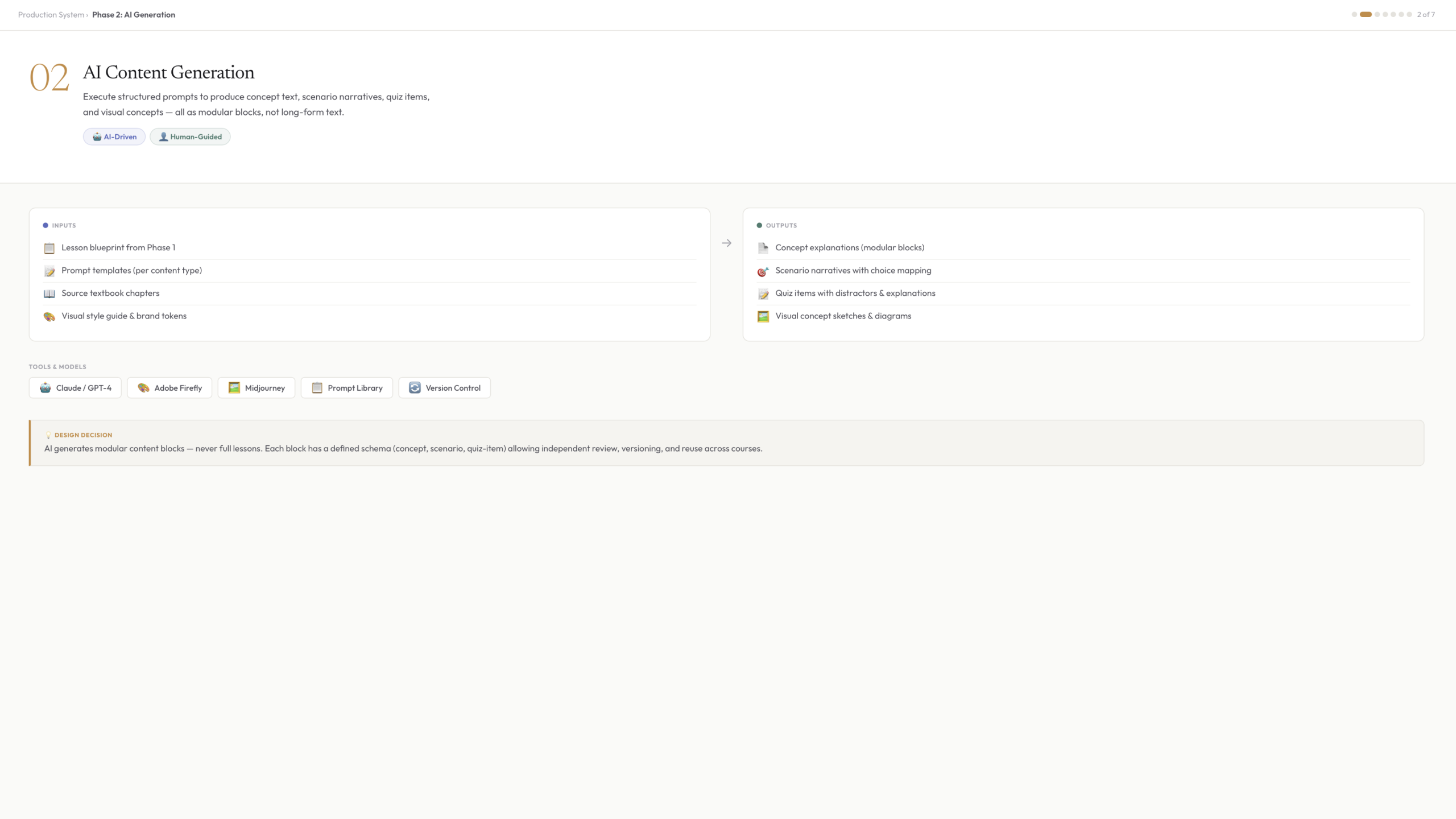
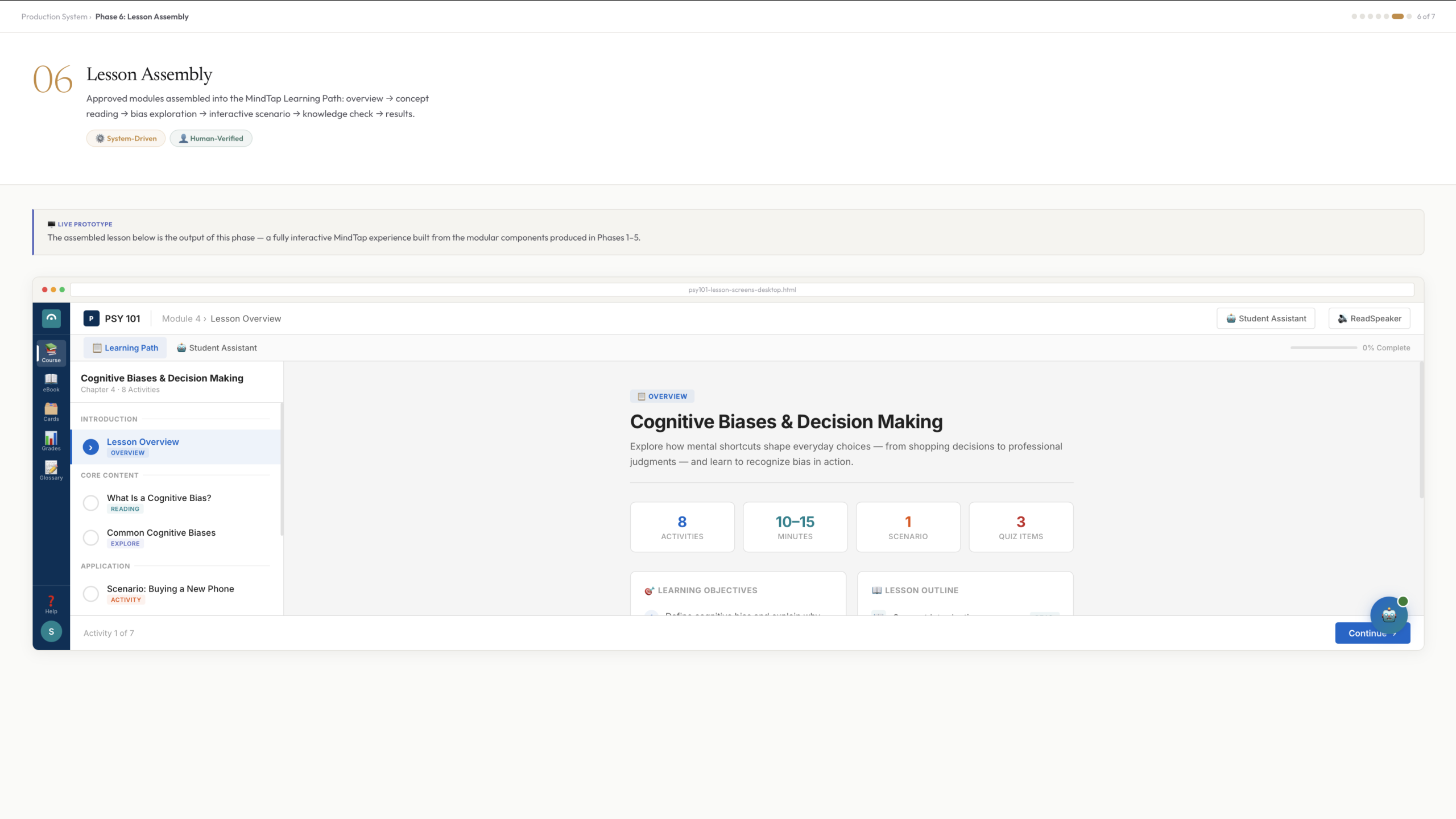
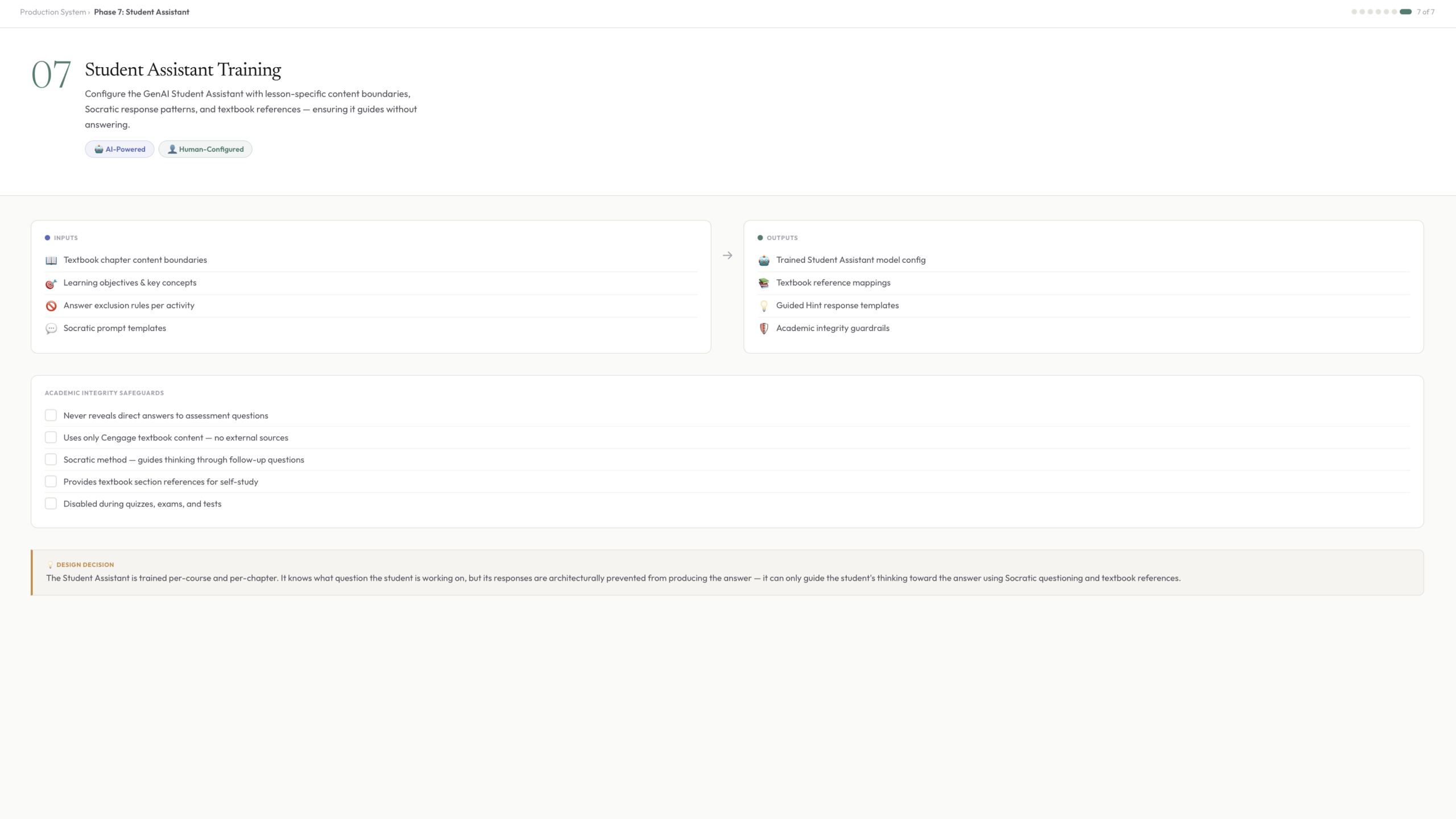
Production system screens — curriculum input, lesson assembly, and Student Assistant configuration.
The Student Assistant uses Cengage's GenAI model to guide thinking through hints and follow-up questions — never revealing answers, always referencing the textbook. The guardrails are architectural, not advisory: the system is incapable of disclosing direct answers regardless of how the question is framed.
8 activity types. Each maps to a MindTap Learning Path plank — modular, reusable, scalable across subjects.
The assembled lesson for PSY 101 — Cognitive Biases — is built to MindTap specifications: Cengage sidebar, Learning Path planks, interactive activities, and the GenAI Student Assistant. Every screen was designed as an independent, reusable component that can scale across subjects without redesign.
Learning objectives, lesson outline, time estimate, and entry point for the module.
AI-drafted explanation with visual diagram, refined by SME review before production.
Expandable concept cards for anchoring, confirmation, and availability bias patterns.
Real-world phone-buying scenario mapping student choices to cognitive bias patterns.
Per-bias results with a teaching moment — not grading performance, but building understanding.
3-question quiz with inline explanations and progress tracking within the Learning Path.
Animated score ring, stats breakdown, and personalized review path for missed concepts.
Cengage GenAI — Socratic method, textbook references, academic integrity guardrails, no direct answers.
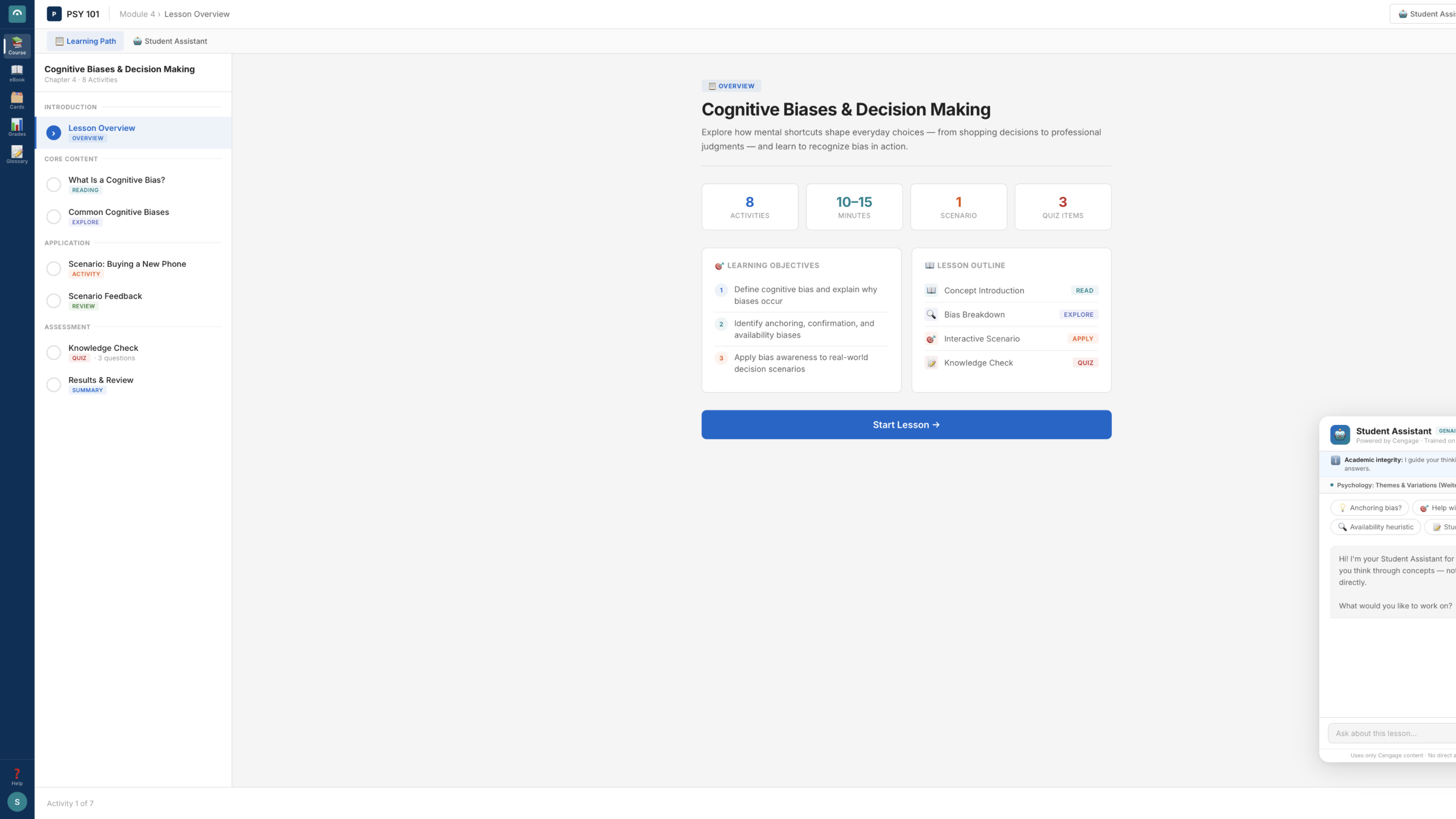
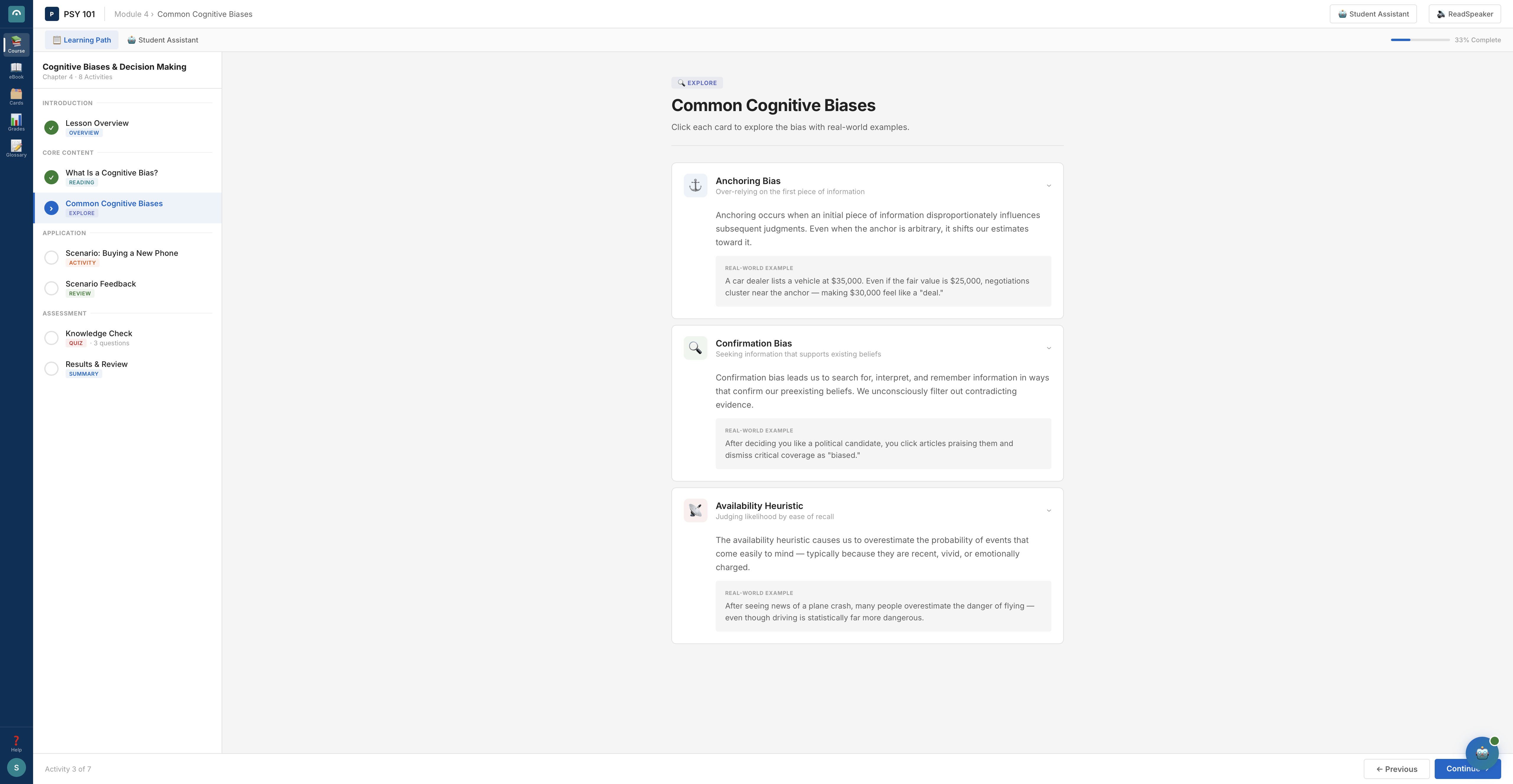
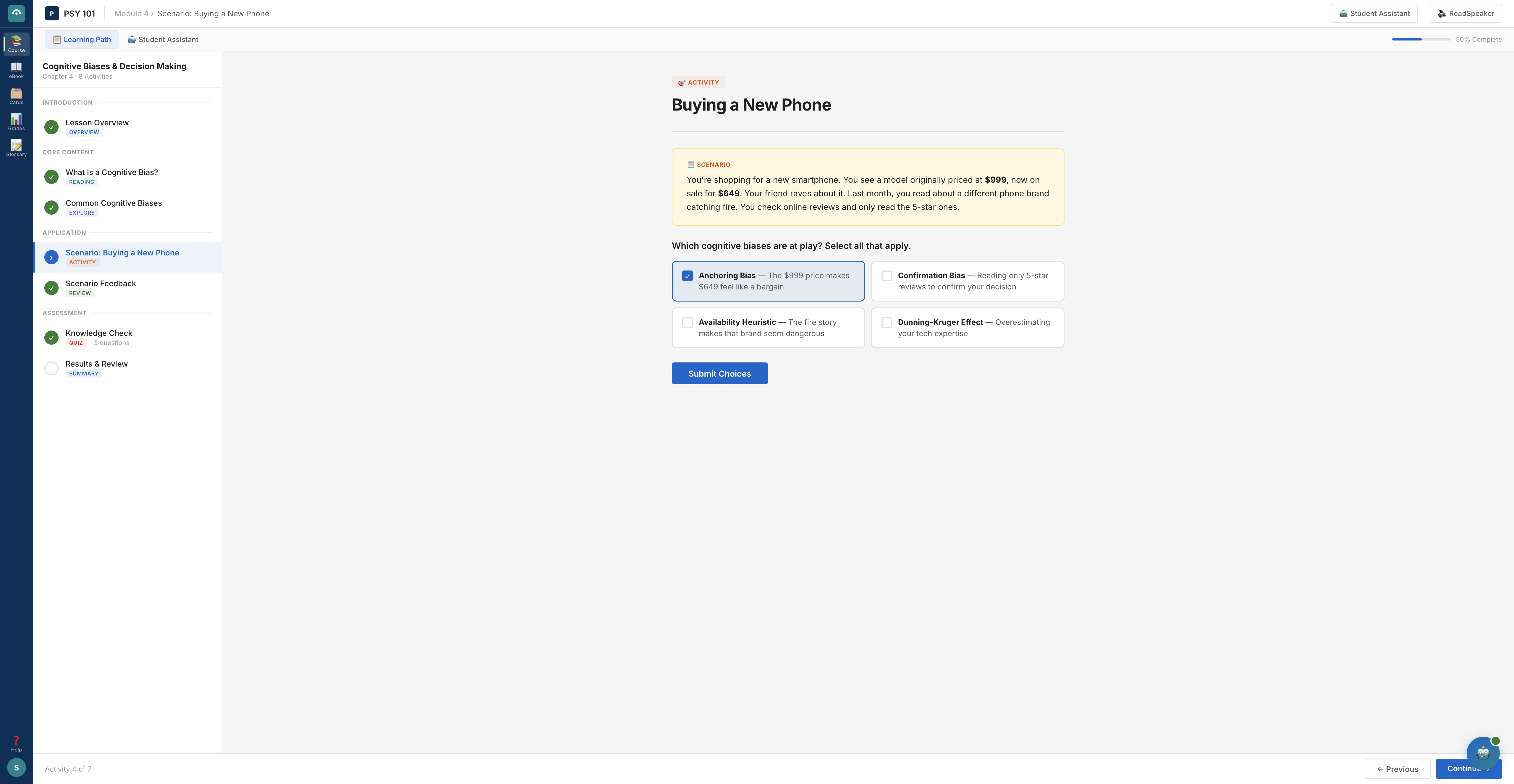
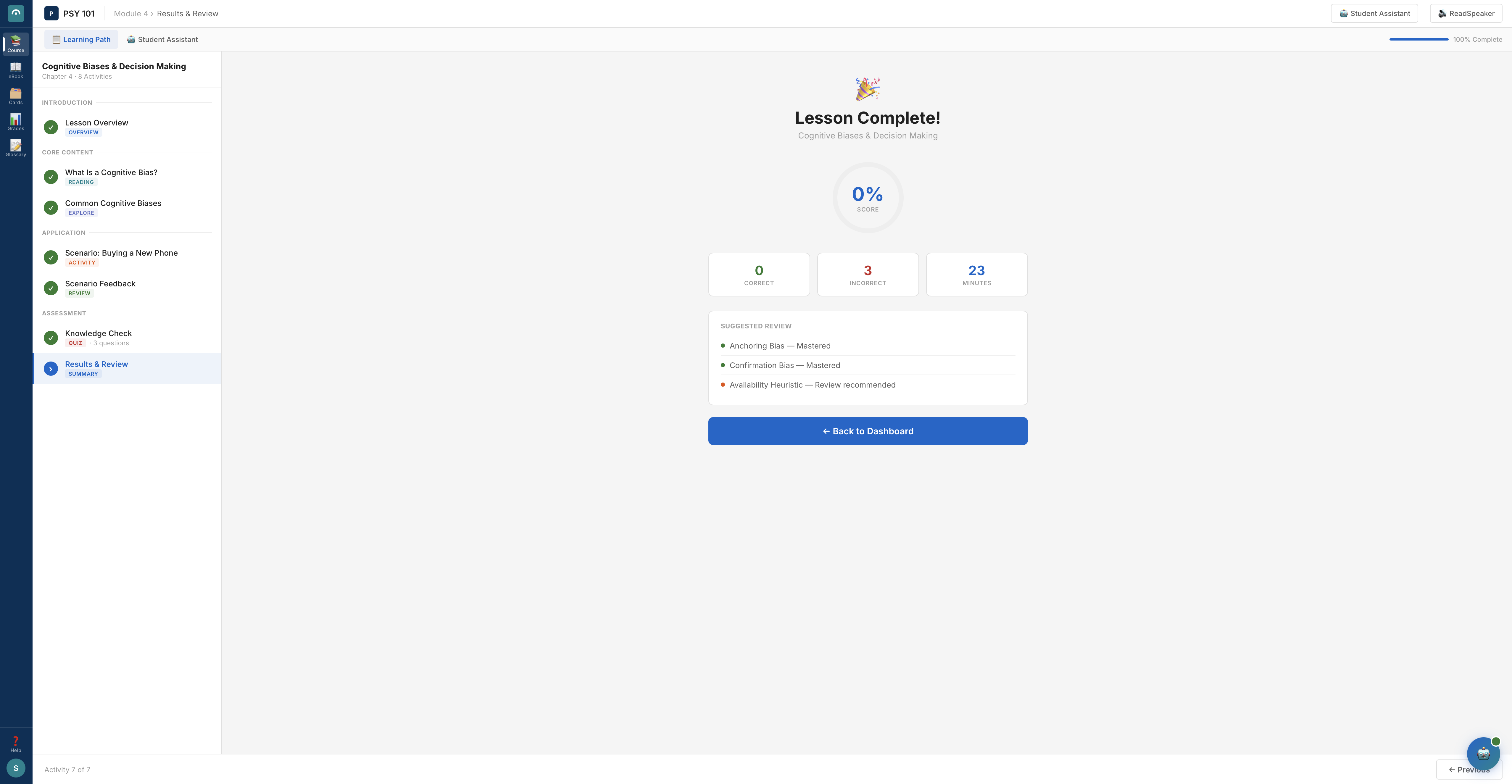
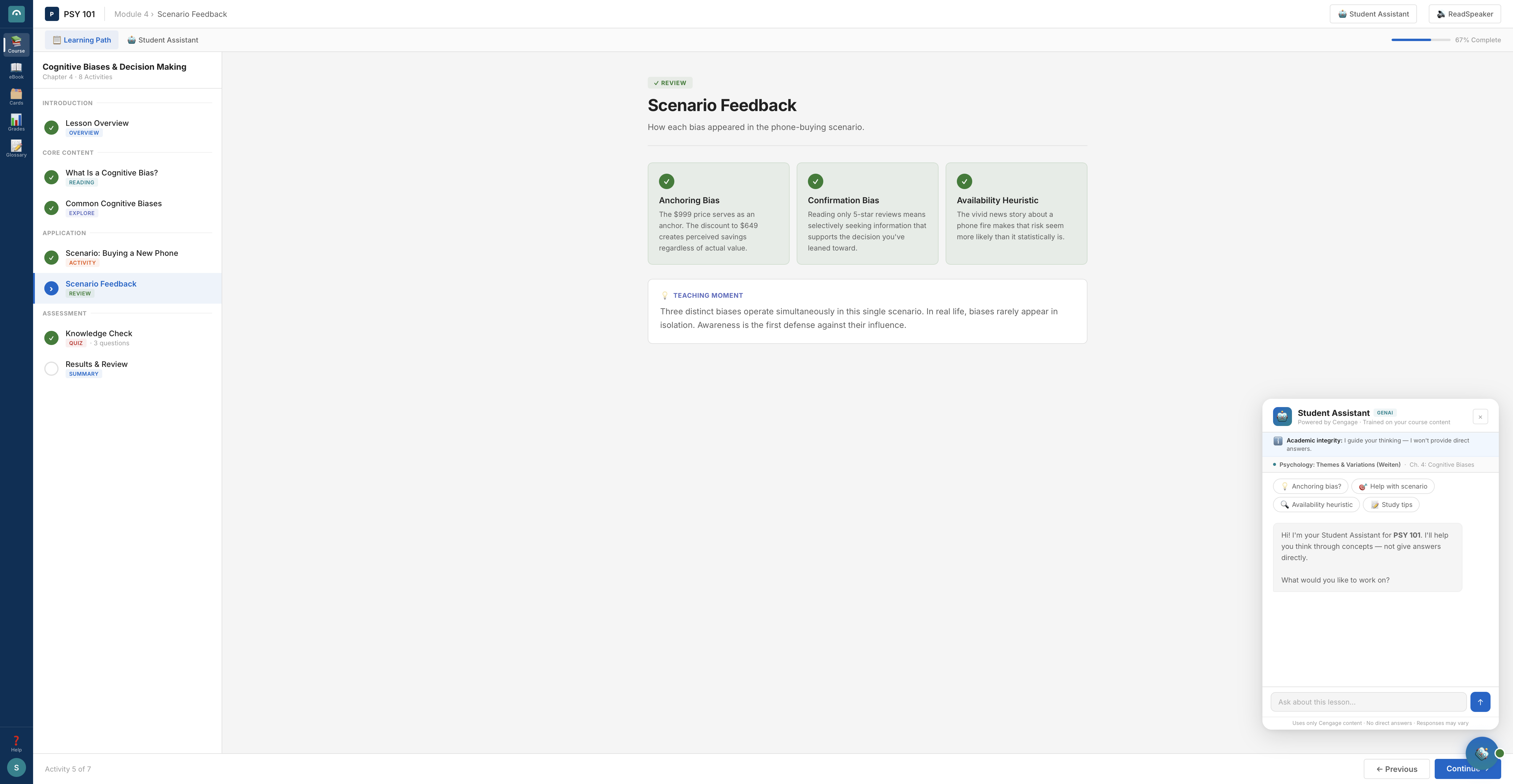
Fully functional MindTap lesson prototype — Chapter 4, 8 activities. Cengage sidebar, Learning Path planks, interactive bias scenario, 3-question knowledge check, and GenAI Student Assistant. Clickable end-to-end.
Every screen maps directly to MindTap's Learning Path architecture — icon sidebar, planks, activity badges, and toolbar — ensuring zero friction for platform integration.
The Student Assistant guides thinking through hints and follow-up questions — never revealing answers, always referencing the textbook. Guardrails are architectural, not advisory.
Content is structured as independent planks — concept cards, scenarios, quizzes — enabling reuse across courses and faster iteration without rebuilding entire lessons.
All AI-generated content verified against source textbook by a subject matter expert before any content enters production.
Language, imagery, and scenarios audited for representation and fairness across all demographic dimensions.
Color contrast, alt text, keyboard navigation, and screen reader compatibility validated on every screen.
Assessments validated against targeted cognitive levels — ensuring quiz items match the stated learning objective tier.
All AI-generated content labeled and documented in production metadata — full transparency at the asset level.
Student Assistant guardrails prevent answer disclosure — architectural constraints, not policy-level restrictions.
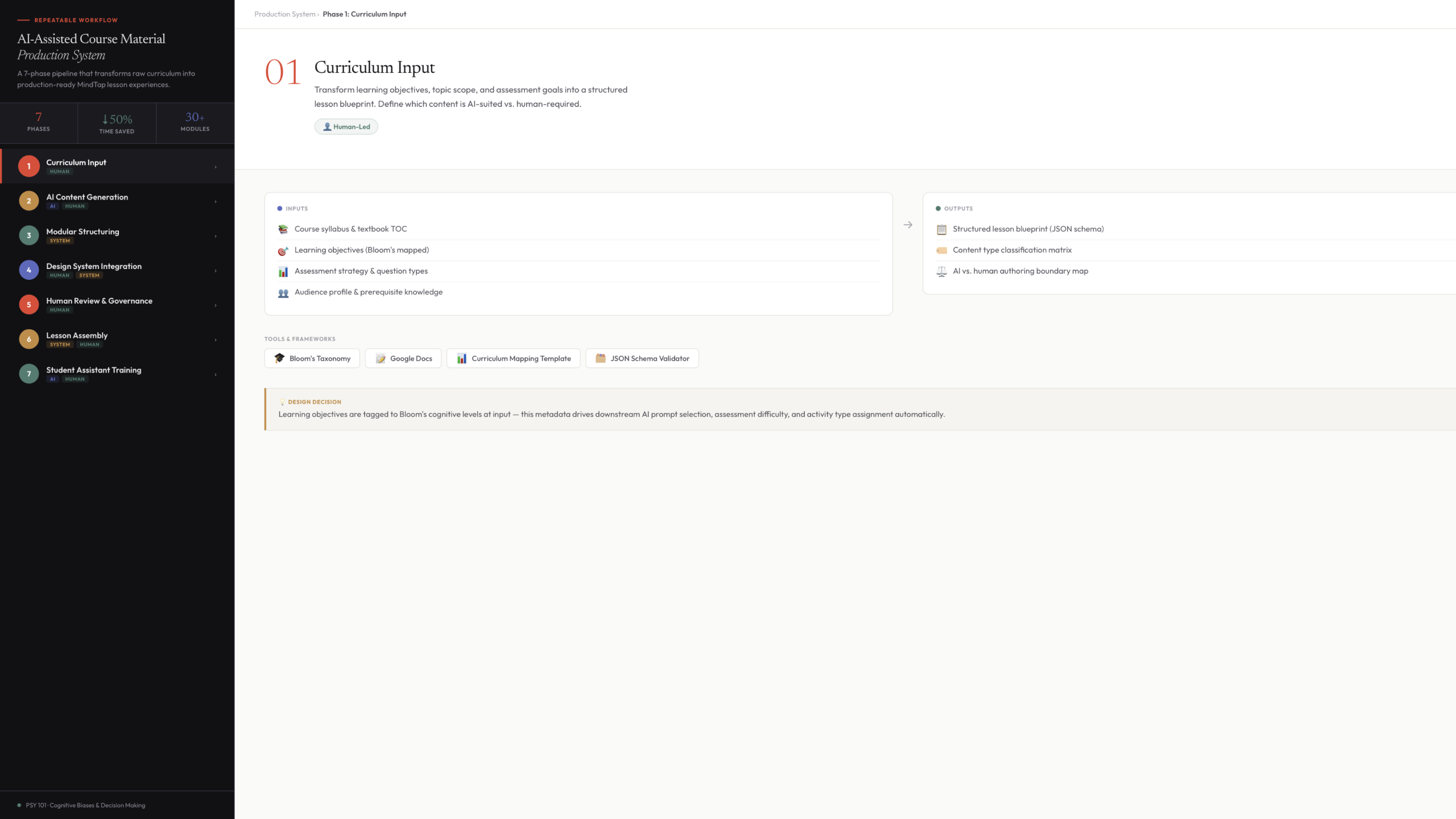
End-to-end system from curriculum input to MindTap-ready lesson, with clear automation boundaries and human-in-the-loop governance at every stage.
Interactive scenarios, formative assessments, and progressive disclosure aligned with Cengage's pedagogical standards and Bloom's taxonomy.
MindTap Learning Path planks, Cengage icon sidebar, activity type badges, and toolbar patterns executed with pixel-level fidelity.
Socratic response patterns, textbook-only content boundaries, academic integrity guardrails, and guided hint architecture — responsible AI by design.
The patterns developed here — the 7-phase pipeline, the modular component library, the contextual Student Assistant embedding — are designed for broader team adoption. Each was documented and validated against Cengage's existing platform and brand standards to ensure they could be handed off, iterated on, and scaled without requiring the original designer's involvement.
Repeatable, production-ready workflows — balancing speed, quality, and consistency through responsible AI integration.