← Back to Work

Case #DM-2016 · Enterprise Platform Redesign · FICO

Debt Manager

Legacy Collections & Recovery Platform Modernization
Enterprise Redesign 2016–2020 Lead Designer
01

The goal: modernize a legacy collections platform trusted by banks, telecoms, governments, and healthcare organizations worldwide.

Duration
4 Years
Sectors
4 Industries
Outcome
Successful Launch

FICO Debt Manager is enterprise software built for the collections and debt recovery lifecycle — used across banking, telecommunications, government, and healthcare to manage the end-to-end process of recovering outstanding accounts. The system had years of functionality built into it, but the interface had aged significantly behind modern expectations.

The redesign wasn't about stripping away what worked. It was about reimagining the user experience flow and modernizing the UI to align with FICO's current brand standards and style guide.

  • Collections agents relied on a UI built for a prior era of enterprise software — dense, non-standard, and slow to navigate.
  • The existing interaction patterns didn't map cleanly to FICO's evolving component standards, creating design debt at every touchpoint.
  • Teams used Axure RP for wireframing, which needed to be translated into final visual designs using the current FICO style guide.
  • Engineering handoffs lacked the precision required for pixel-accurate implementation — annotations and specs were inconsistent.
  • Design consistency had to be maintained across a sprawling feature set while keeping cross-functional teams aligned throughout.
Debt Manager — early interface Debt Manager — legacy patterns

The platform before modernization — functional but misaligned with current standards and user expectations.

“Collections agents don't have time to think about the interface. The system has to get out of their way and let them focus on the work.”
— Design direction, FICO Debt Manager

As lead designer, the work spanned the full end-to-end design process — from early-stage discovery through production QA — across multiple workstreams simultaneously, adapting to the pace and complexity of a four-year development cycle.

02

Four years of iterative redesign — each phase building on the last, informed by daily builds, cross-functional feedback, and the evolving FICO brand standards the product had to align to.
Iteration 00
The baseline — understanding the legacy system
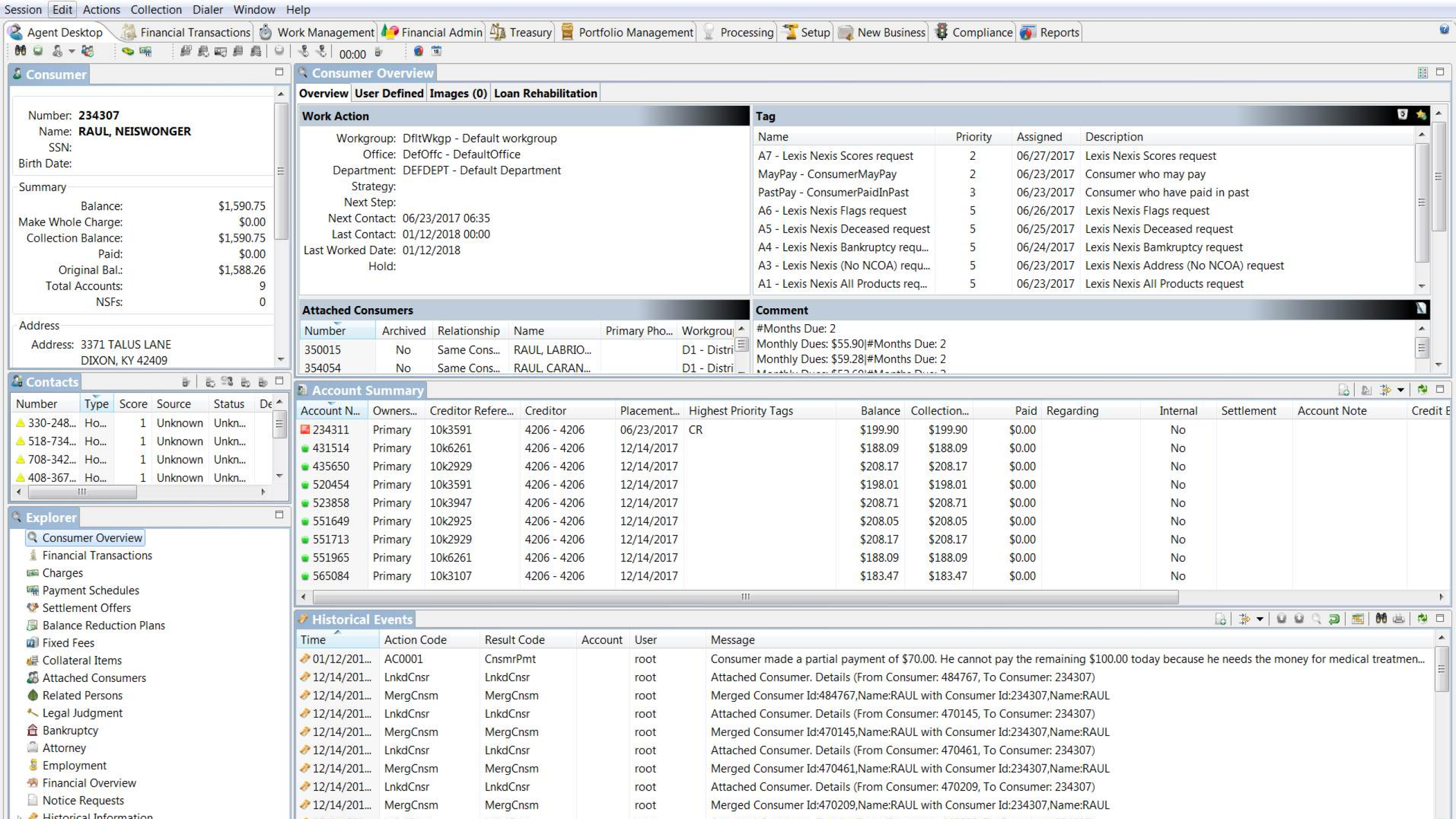
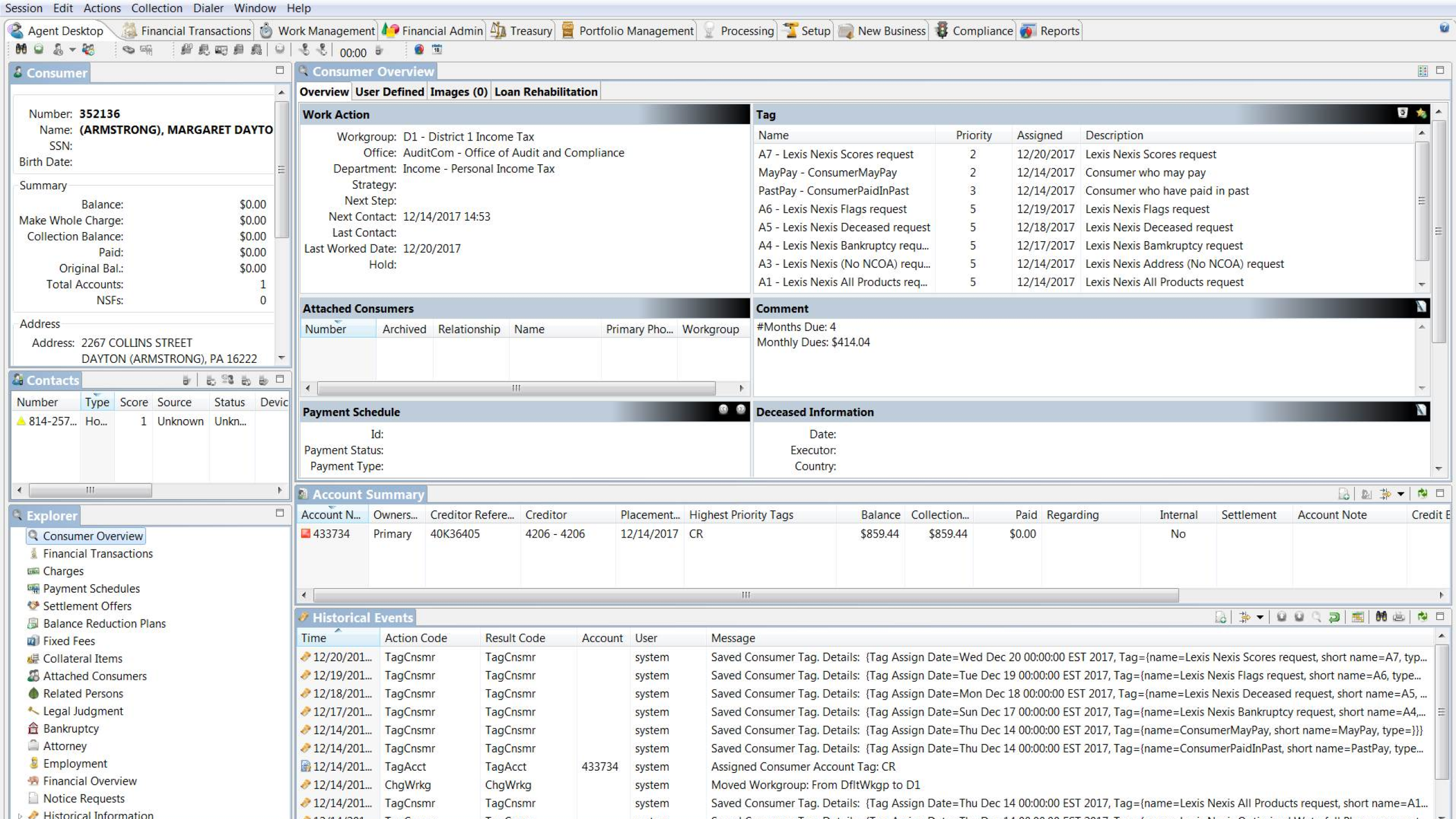
Before any design decisions, the work started with deep understanding of the existing system. Collections workflows, account management flows, and the specific mental models of debt recovery agents shaped everything that came next.
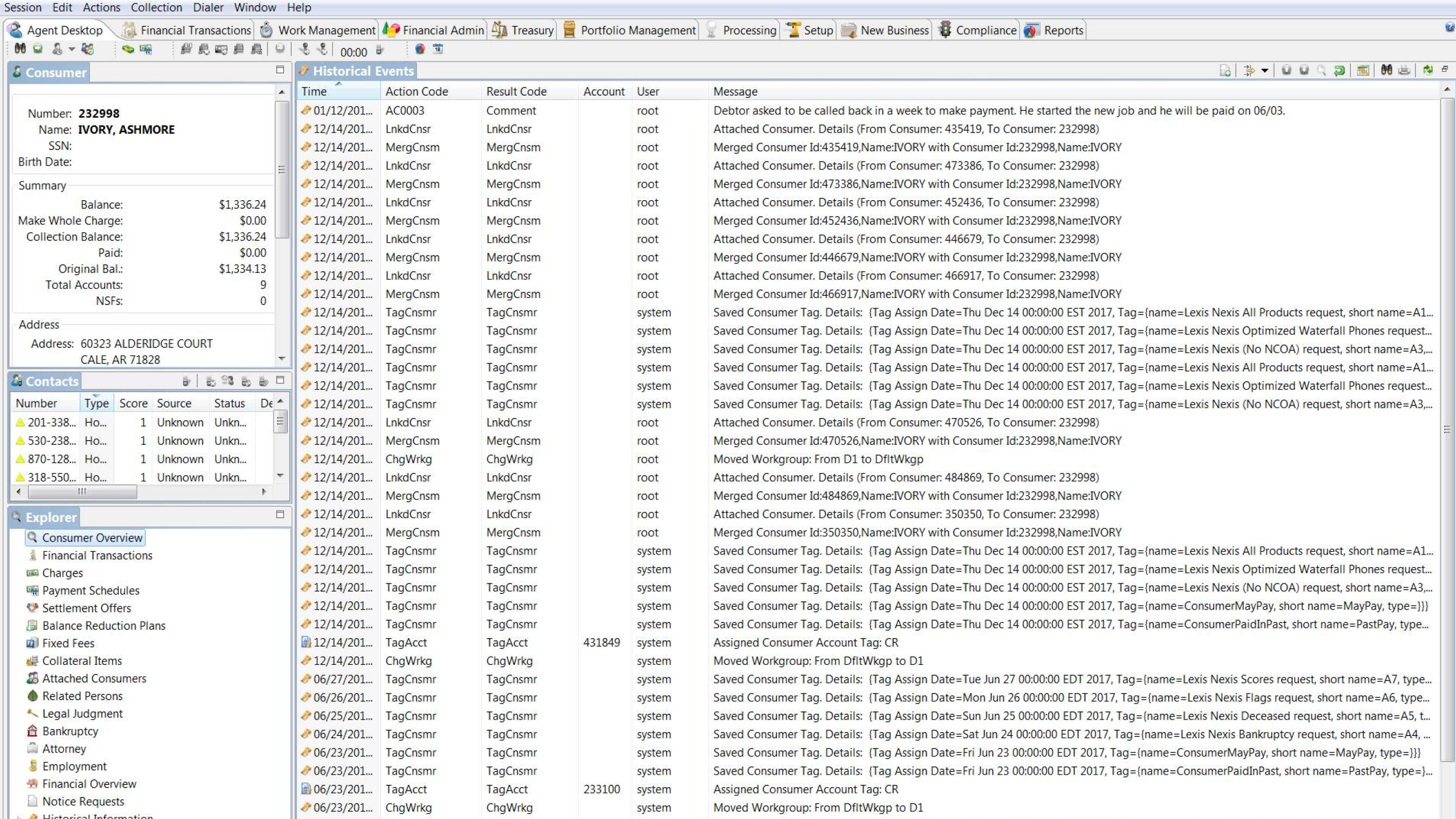
Debt Manager legacy — Consumer Overview full dashboard (RAUL, NEISWONGER) Debt Manager legacy — Consumer Overview (ARMSTRONG, MARGARET)

The legacy Agent Desktop — Historical Events, Workchain selection, and Consumer Overview screens before modernization.

Before
Dense legacy UI built for an older generation of enterprise software
After
Modernized interface aligned to FICO brand standards and updated UX conventions
Iteration 01
UX design support — discovery, flows, and wireframes
Early-stage discovery set the foundation. Contributing to user flows, wireframes, and design strategy during the discovery and iteration phases meant working across every layer of the experience — from high-level information architecture down to interaction details.
Debt Manager — user flow and navigation prototype

Homepage redesign — one of many user-flows and wireframes produced during the early design phase.
Before
Functional requirements with no clear visual or interaction direction
After
Structured user flows and wireframes that gave the team a shared design language
Iteration 02
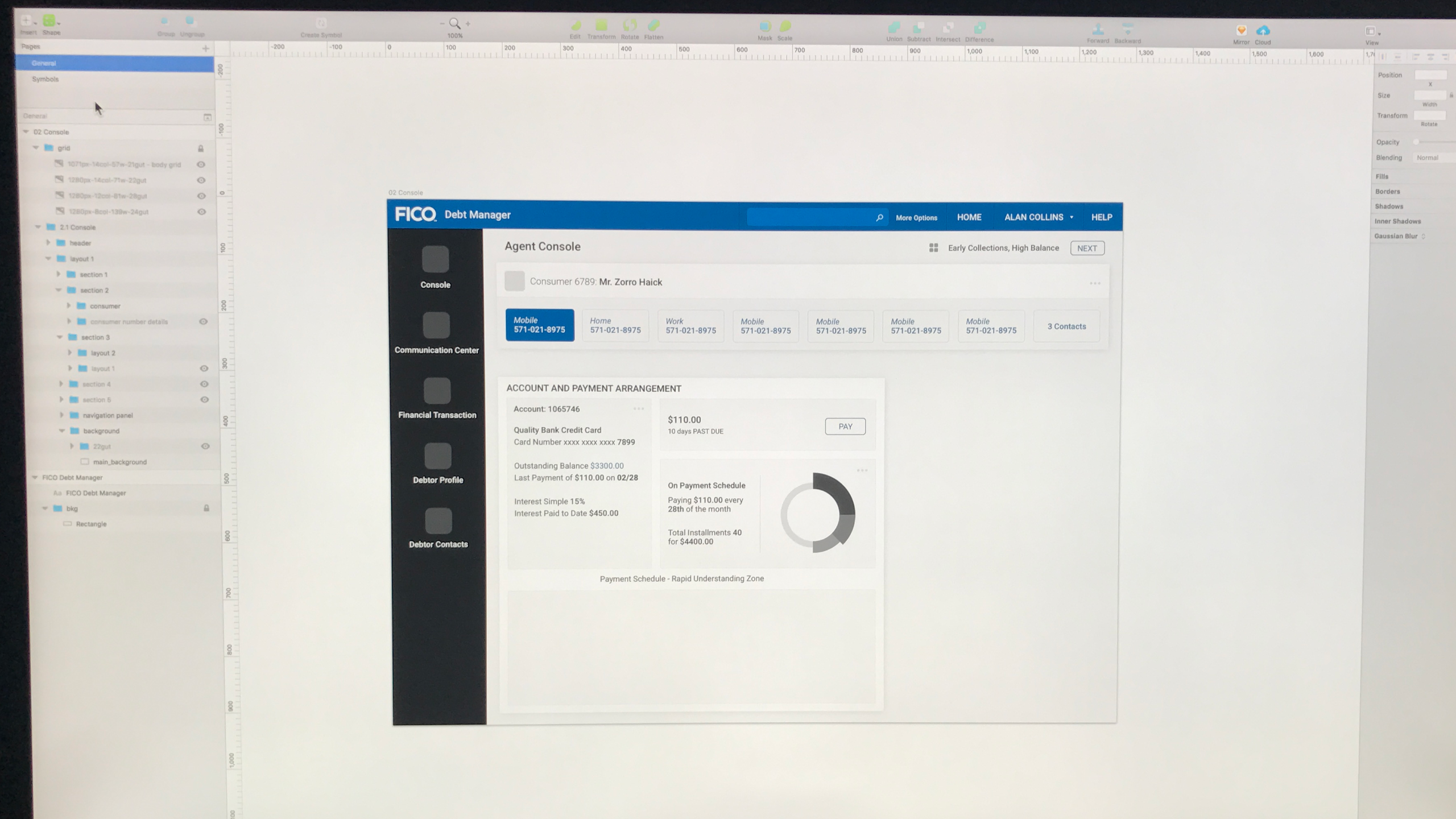
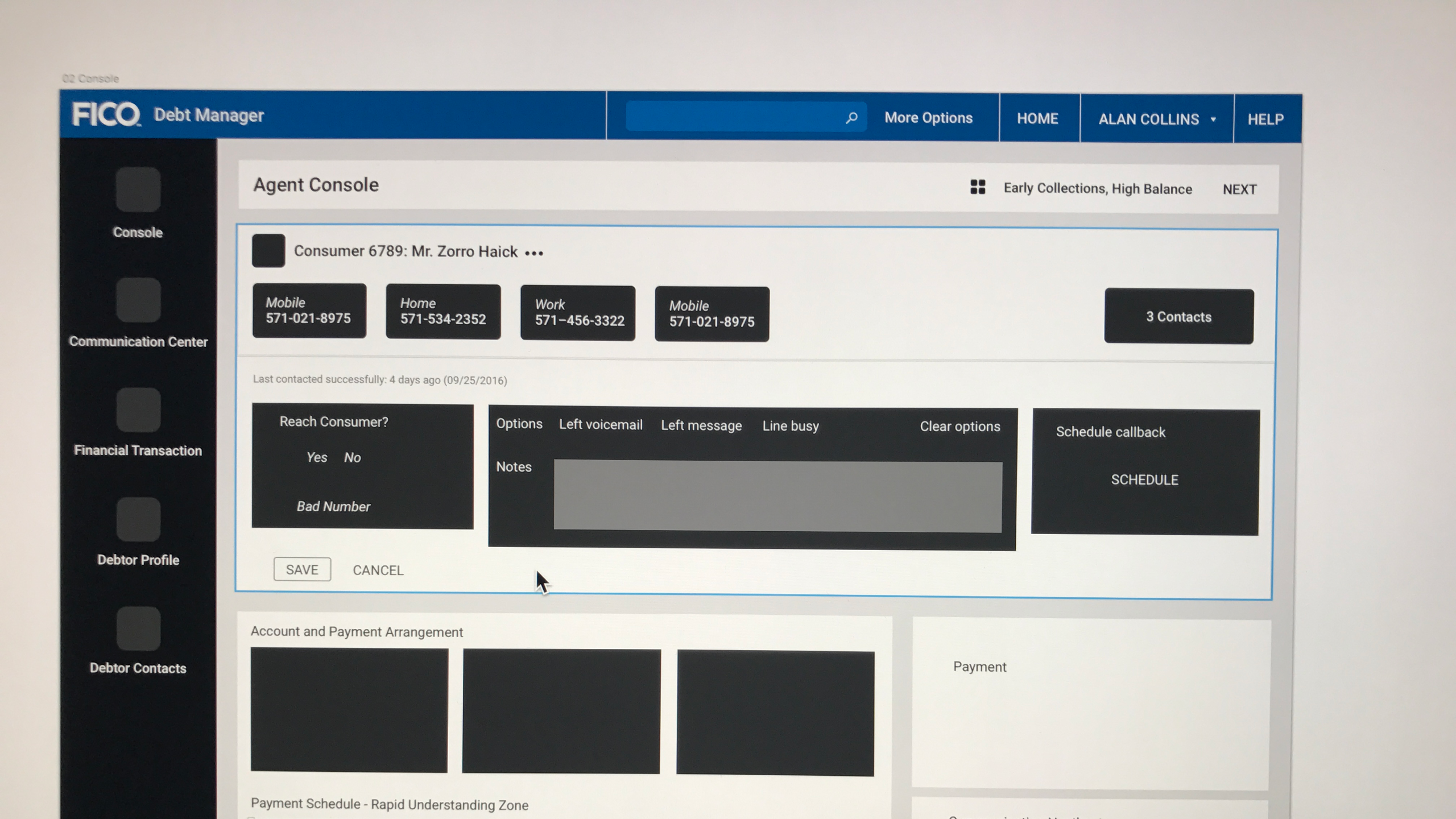
UI design — from Axure wireframes to polished Sketch designs
The core production work of the project: taking Axure wireframes and converting them into fully realized visual designs in Sketch, applying the current FICO style guidelines throughout. This wasn't a simple visual pass — it required judgment about how to adapt existing FICO components to Debt Manager's specific interaction patterns, edge cases, and data-heavy layouts without creating one-off solutions that would compound technical debt.
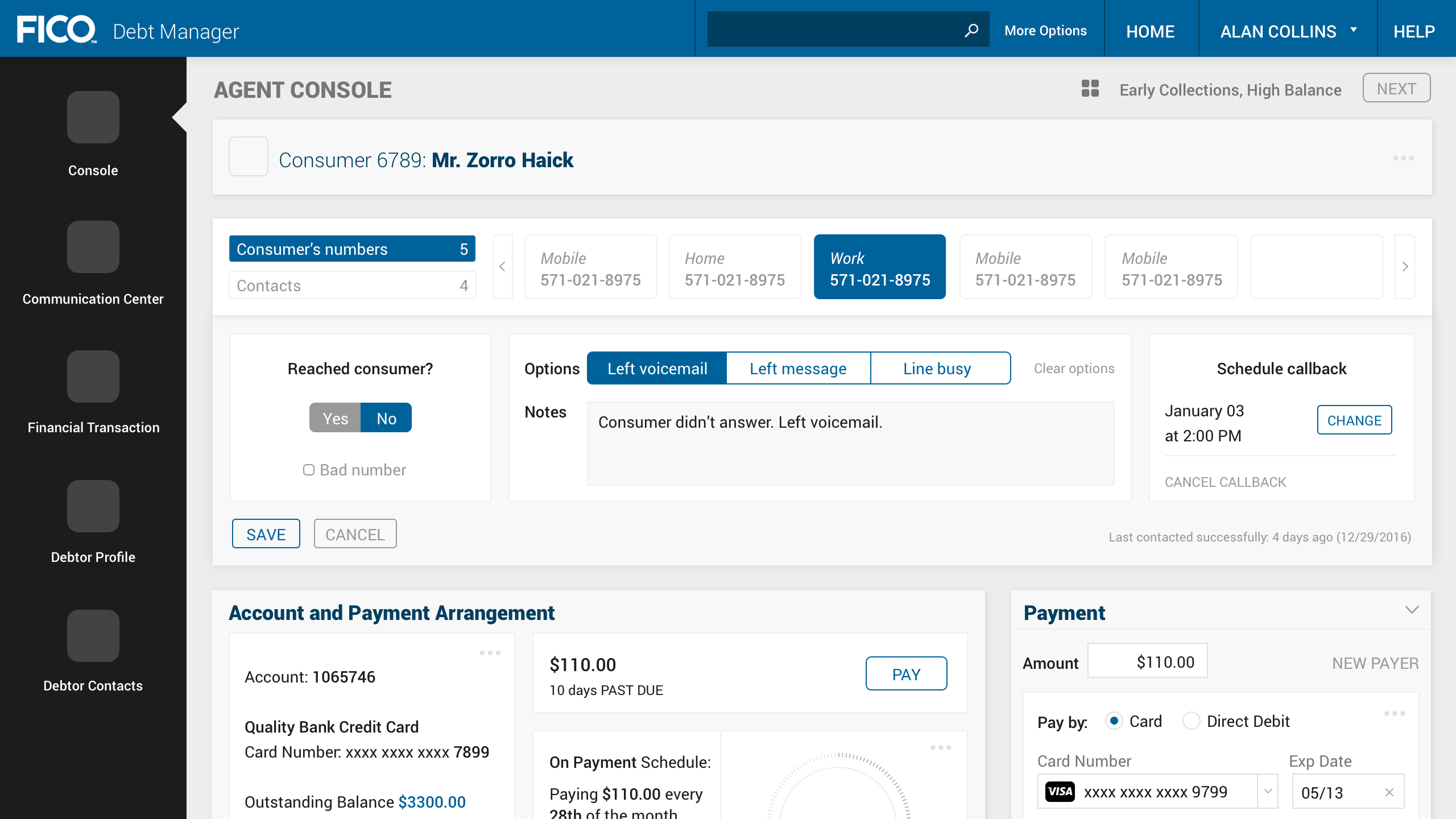
Debt Manager — Agent Console in Sketch, early design stage Debt Manager — Agent Console dark prototype, Reach Consumer interaction Debt Manager — Agent Console polished final design Debt Manager — Account and Payment Arrangement in Sketch, Credit Card Declined state
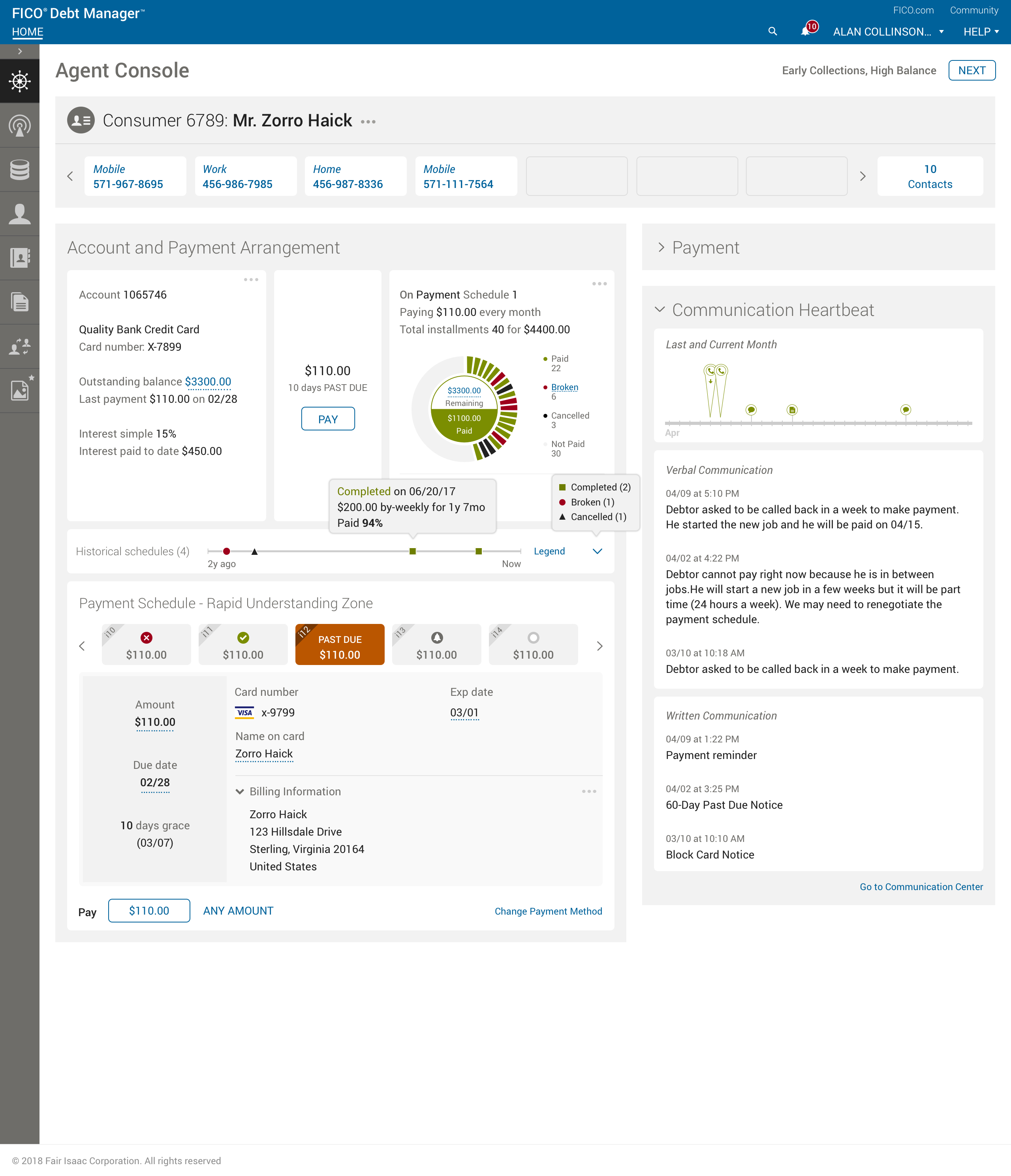
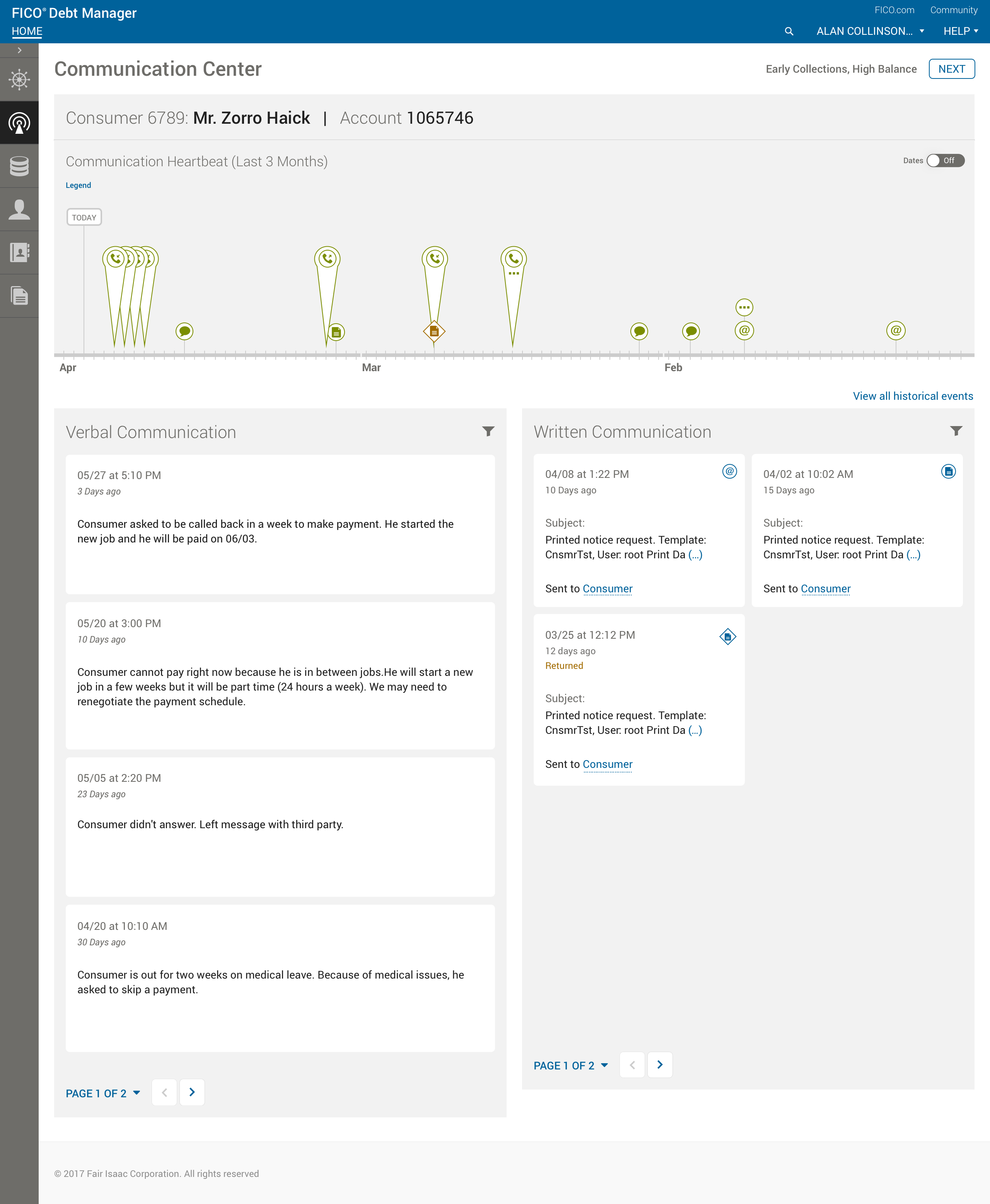
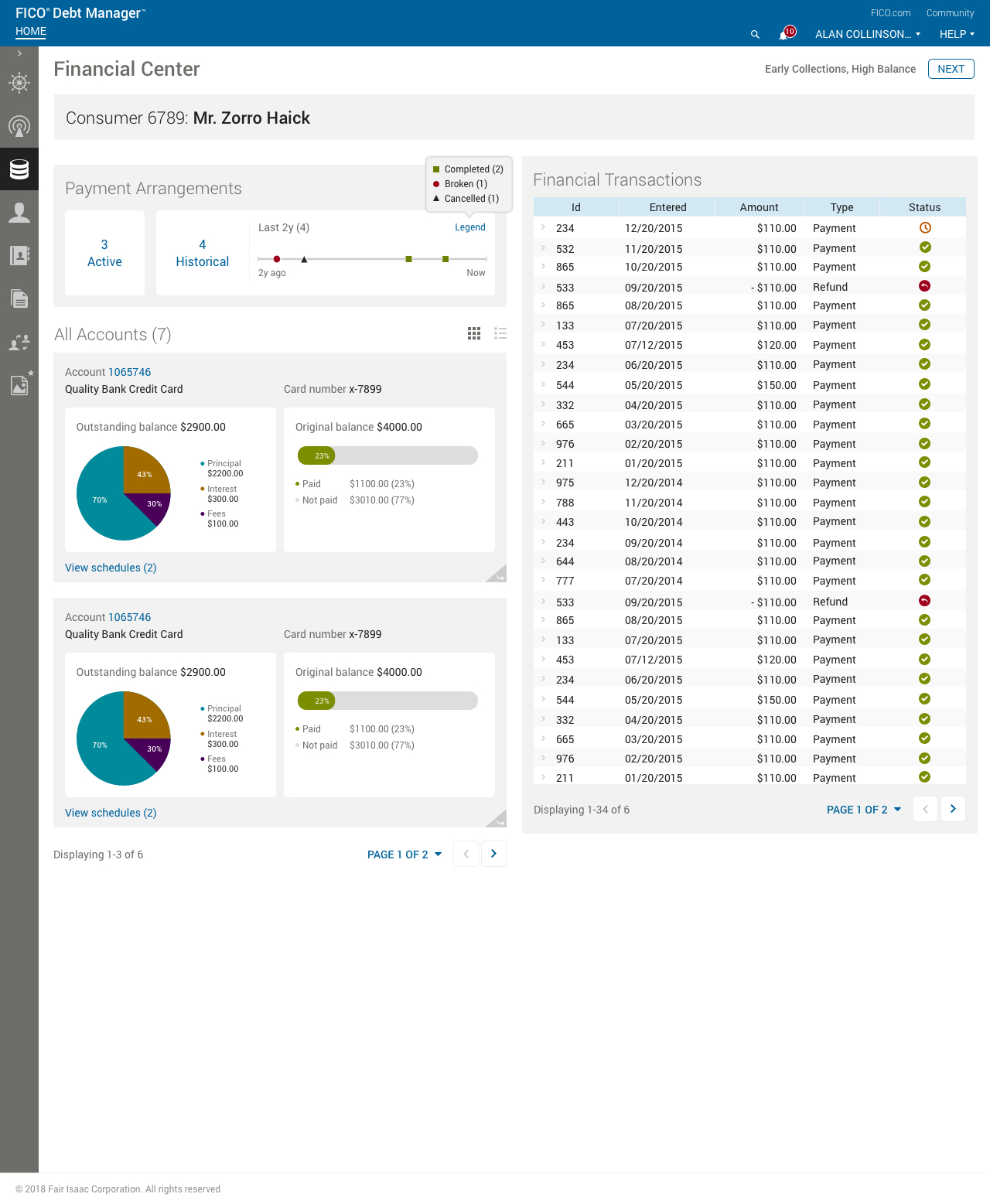
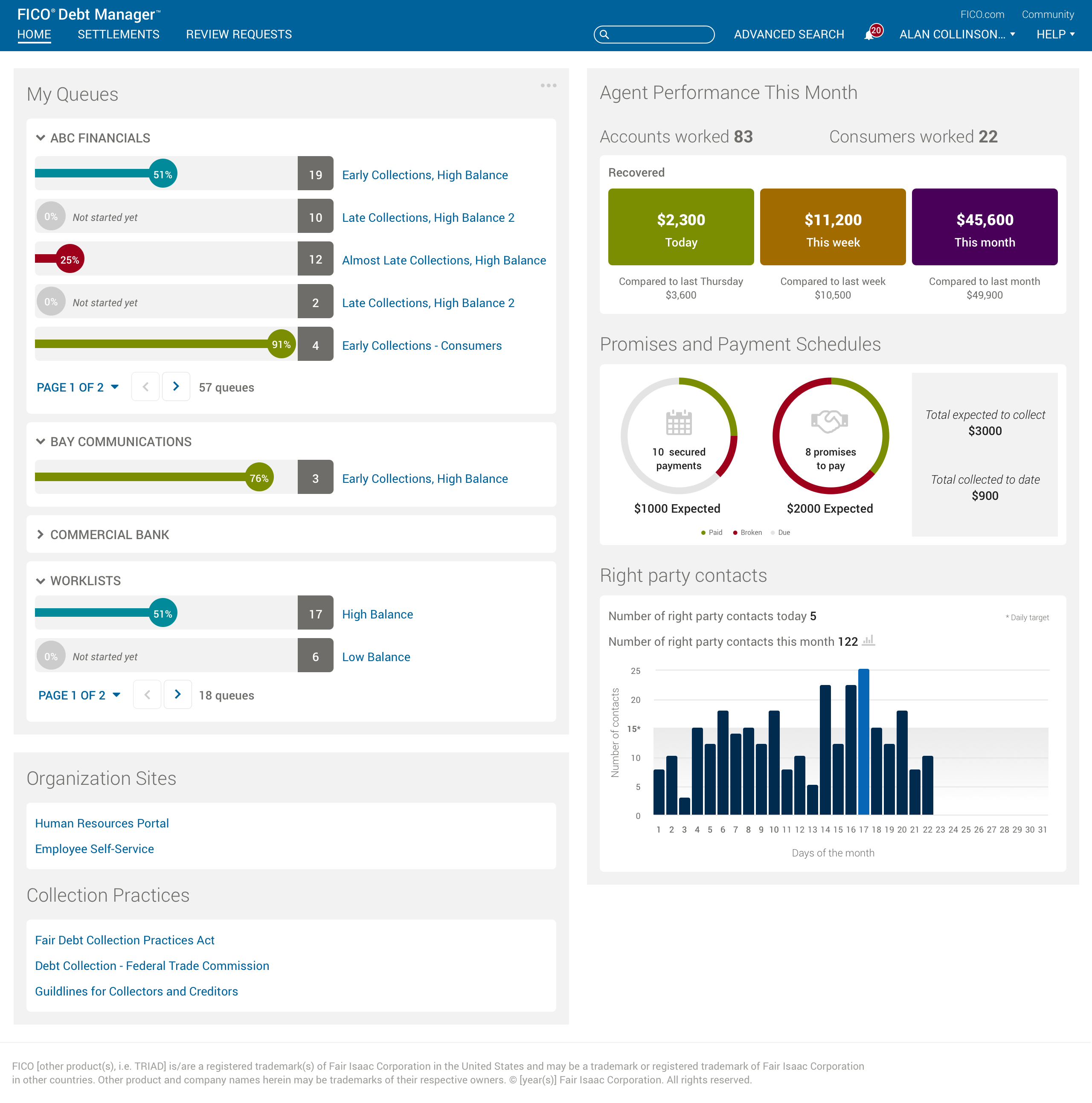
Debt Manager — Agent Console, polished Sketch design Debt Manager — Communication Center, polished Sketch design Debt Manager — Financial Center, polished Sketch design Debt Manager — Home Dashboard, polished Sketch design

Four of the primary screens — Agent Console, Communication Center, Financial Center, and Home Dashboard — fully realized in Sketch.
Before
Axure wireframes — functional scaffolding without visual resolution
After
Production-ready Sketch designs built on FICO style foundations
Iteration 03
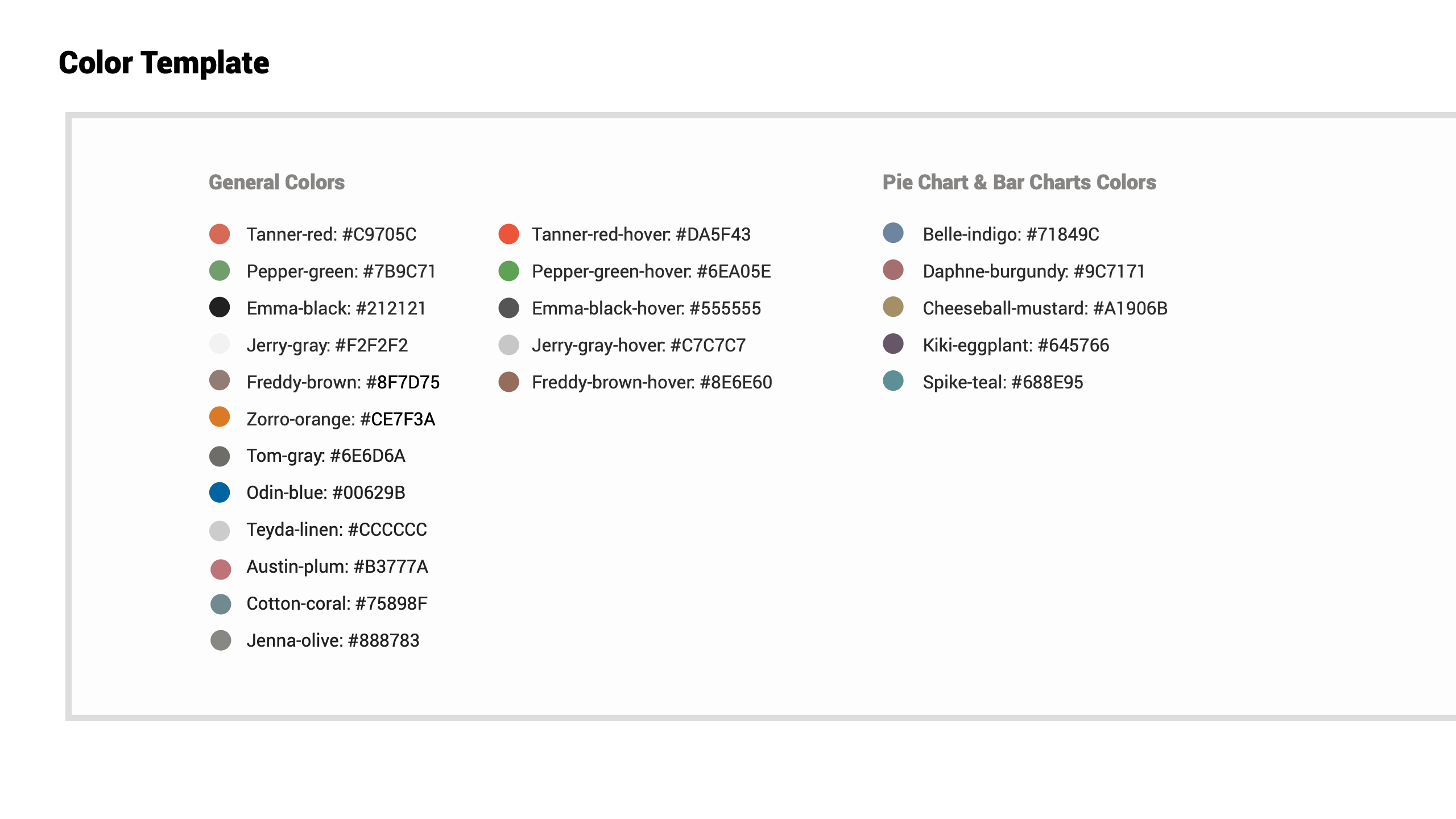
Engineering handoff — annotations and specifications
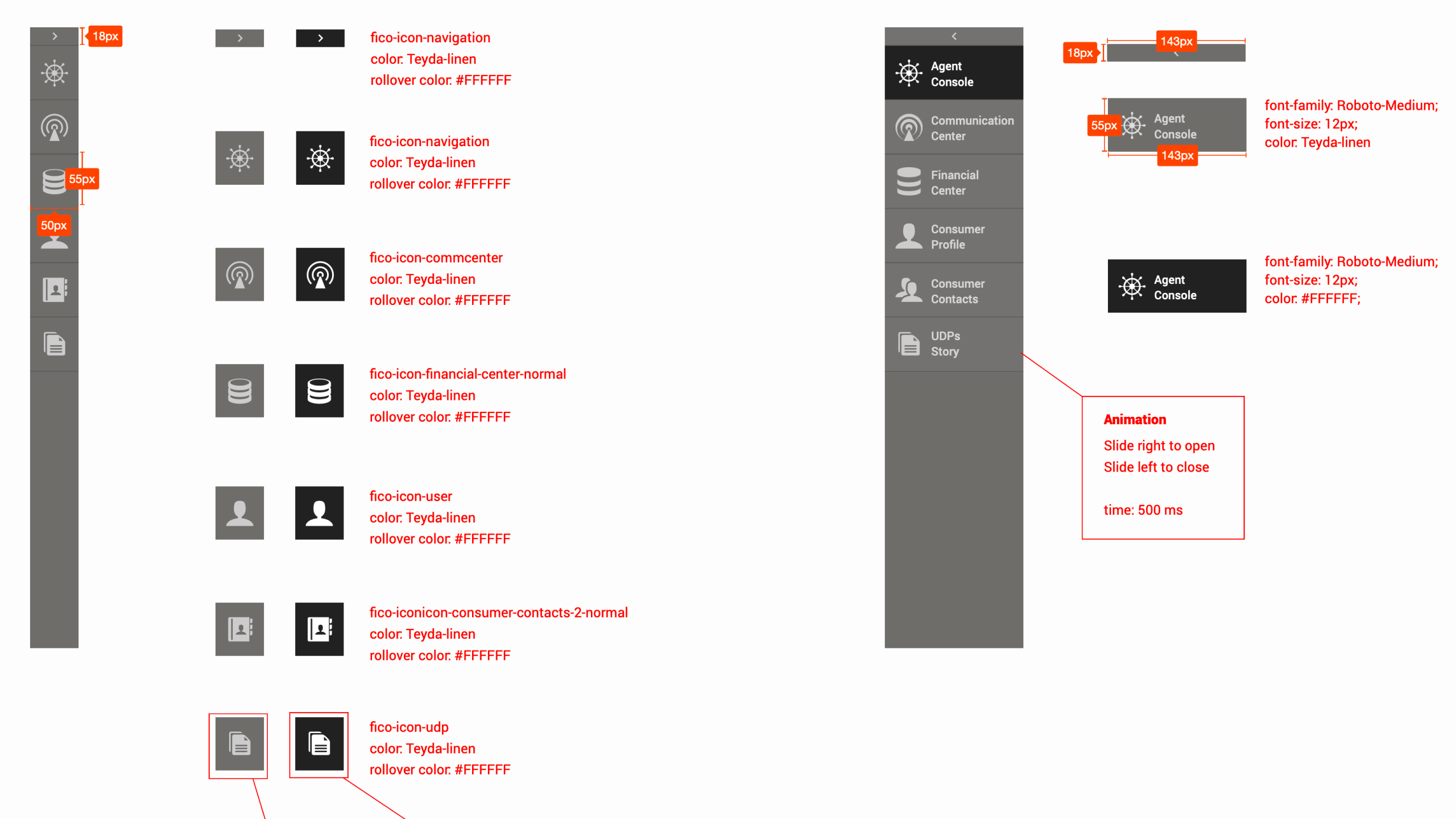
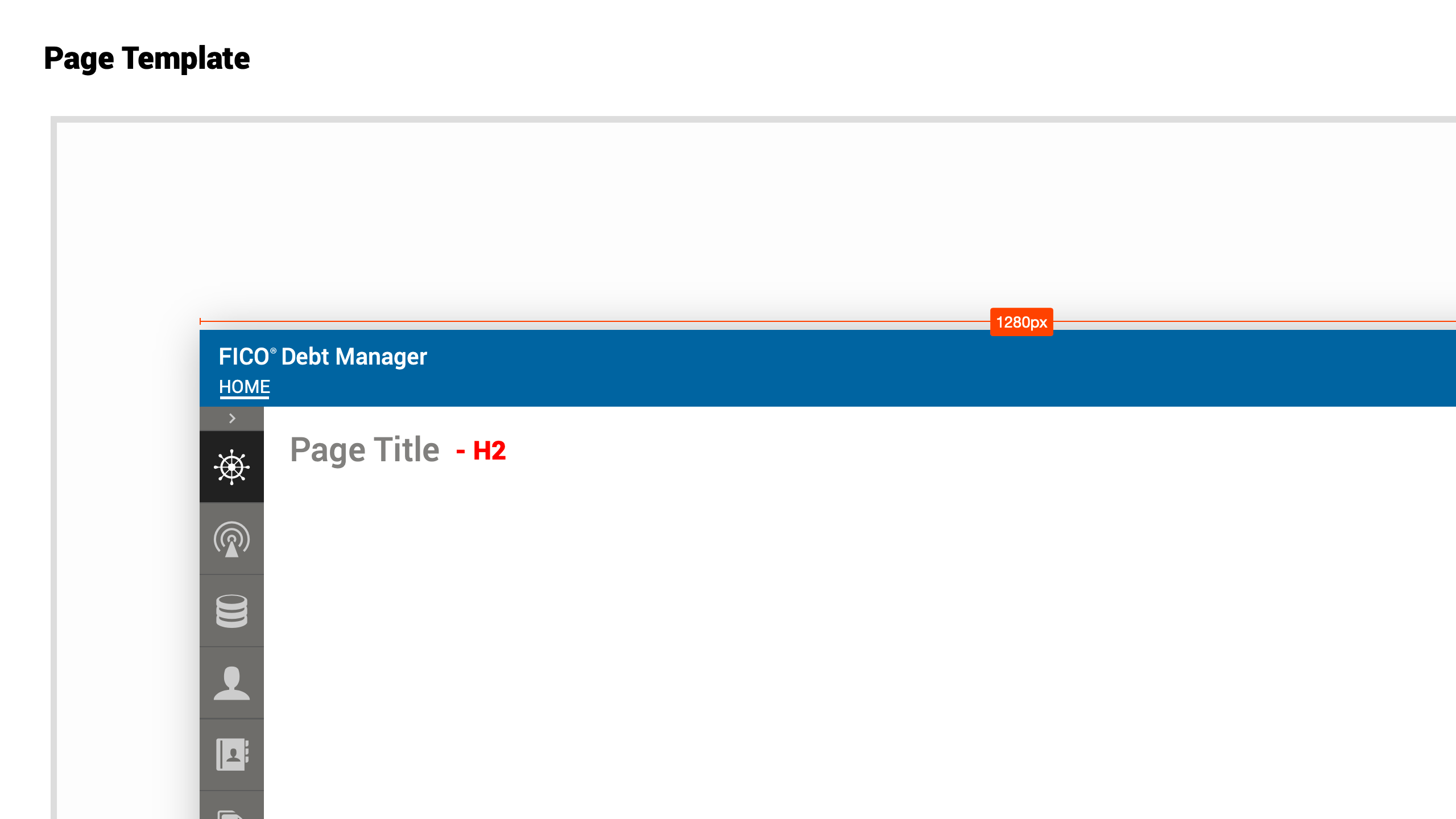
Accurate implementation requires more than finished comps. Producing detailed design annotations and specifications — covering spacing, interaction states, data behaviors, and edge cases — ensured engineers had everything needed to build exactly what was designed. This was particularly important for a system as data-dense as Debt Manager, where minor implementation variations in table layouts or form behaviors had real impact on workflow efficiency.
Debt Manager — color template and system palette documentation Debt Manager — page template with navigation and layout specifications Debt Manager — navigation icon specifications with dimensions and states Debt Manager — group canvas layout annotations and spacing rules
Before
Static comps handed off without the context engineers needed to implement precisely
After
Detailed annotations and specs that closed the gap between design intent and built output
Iteration 04
Design QA — reviewing daily builds
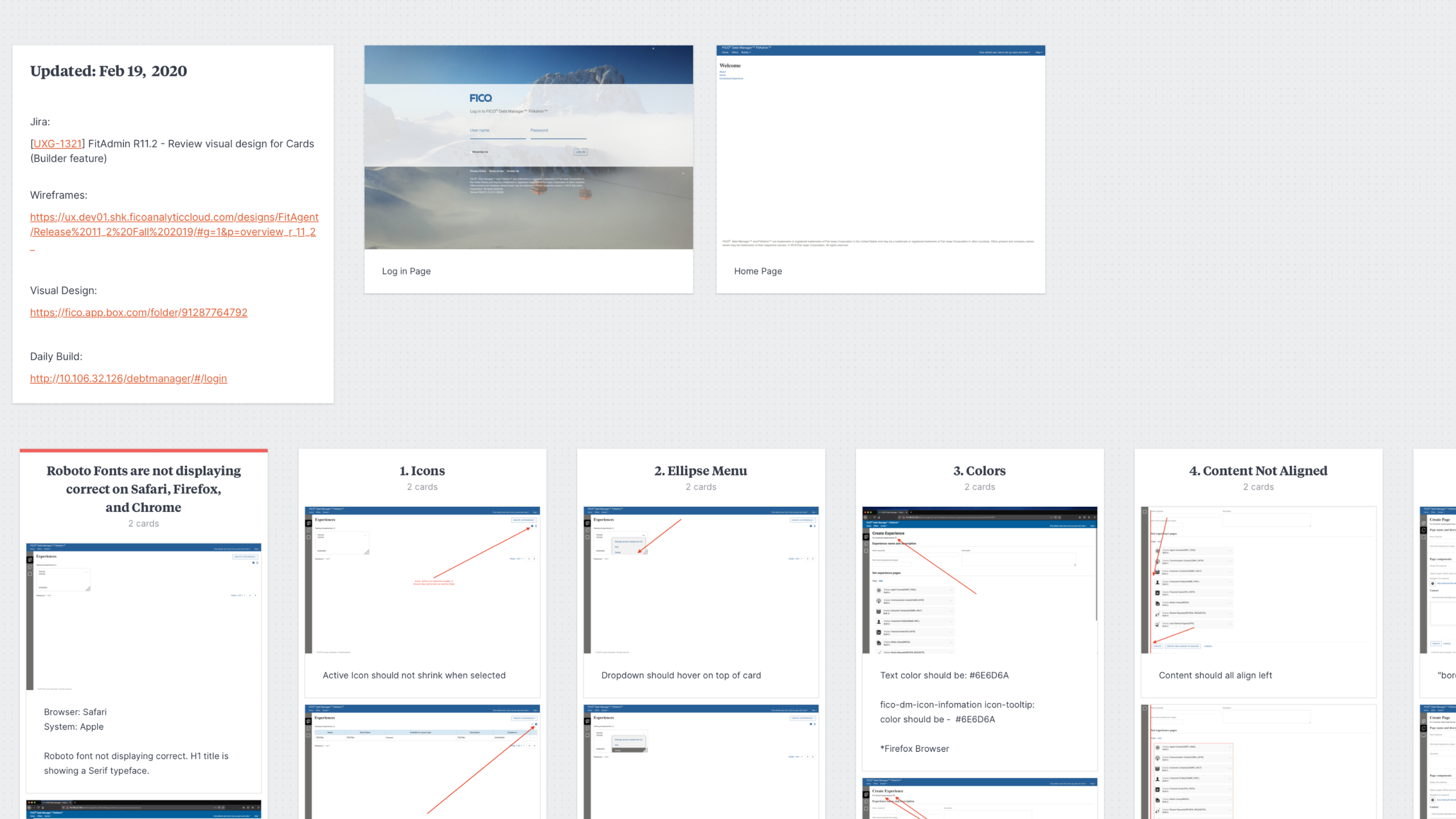
Quality assurance ran throughout the entire development cycle. Reviewing daily builds meant catching design drift early — spacing inconsistencies, component mismatches, and interaction deviations that would compound if left unchecked. This wasn't a final review step; it was a continuous feedback loop that kept implementation aligned to design intent across months of development.
Debt Manager — visual design defect report: Consumer Contacts page QA Debt Manager — visual design defect reports: Communication Center and Agent Console QA Debt Manager — QA review
Before
Design drift accumulating across builds with no structured review process
After
Daily QA cycles catching deviations before they became systemic issues
03
01
Successful Platform Launch
Following four years of redesign and development, the modernized Debt Manager launched successfully — with positive reception from collections teams across banking, telecom, government, and healthcare.
02
Brand-Aligned Experience
The redesigned system brought Debt Manager into alignment with FICO's current design language — establishing a consistent visual and interaction standard across the collections and recovery workflow.
03
Cross-Functional Delivery
A sustained collaboration across stakeholders, product managers, engineers, and designers — maintaining design consistency and implementation accuracy across the full development lifecycle.
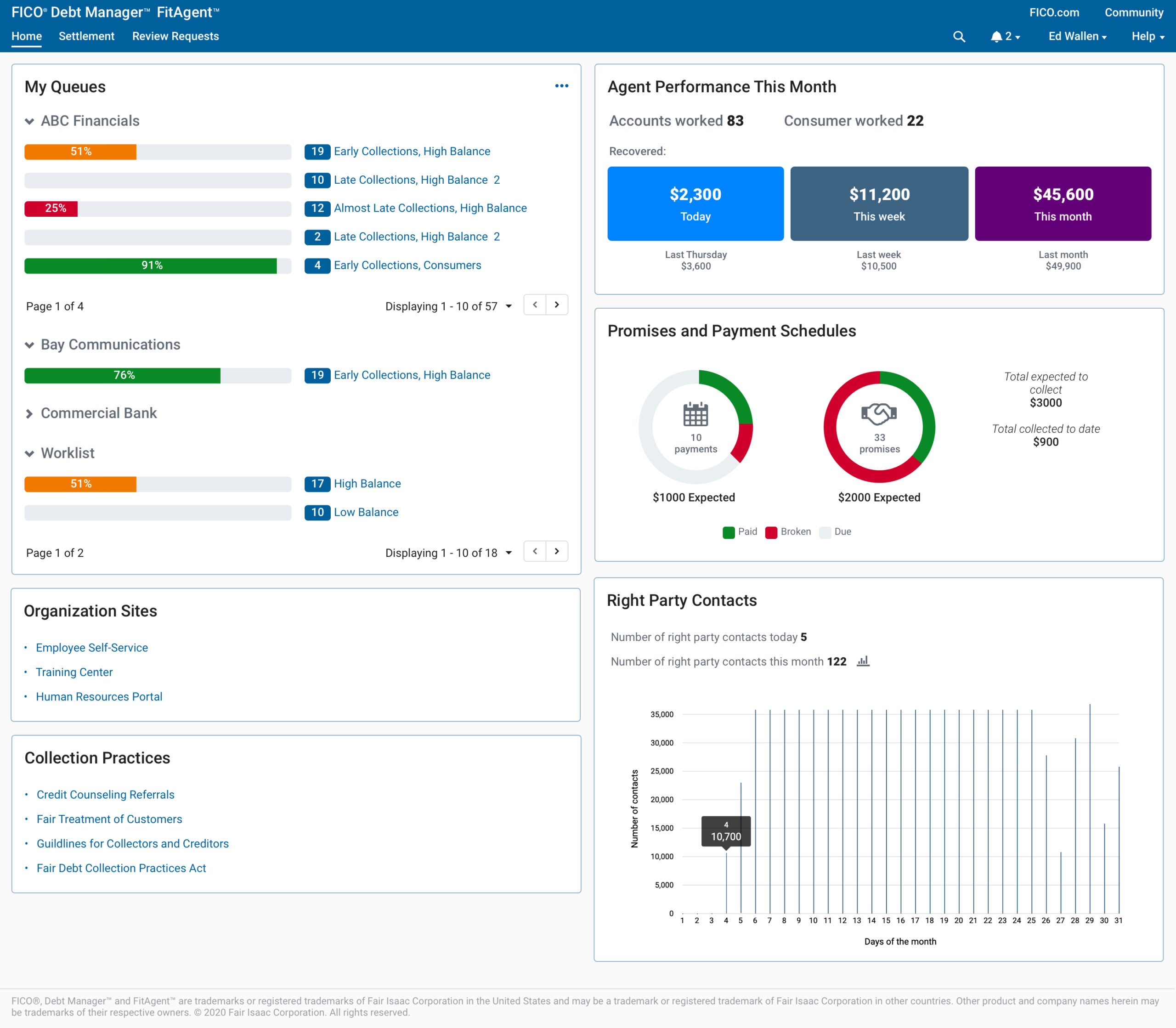
Debt Manager FitAgent — Final
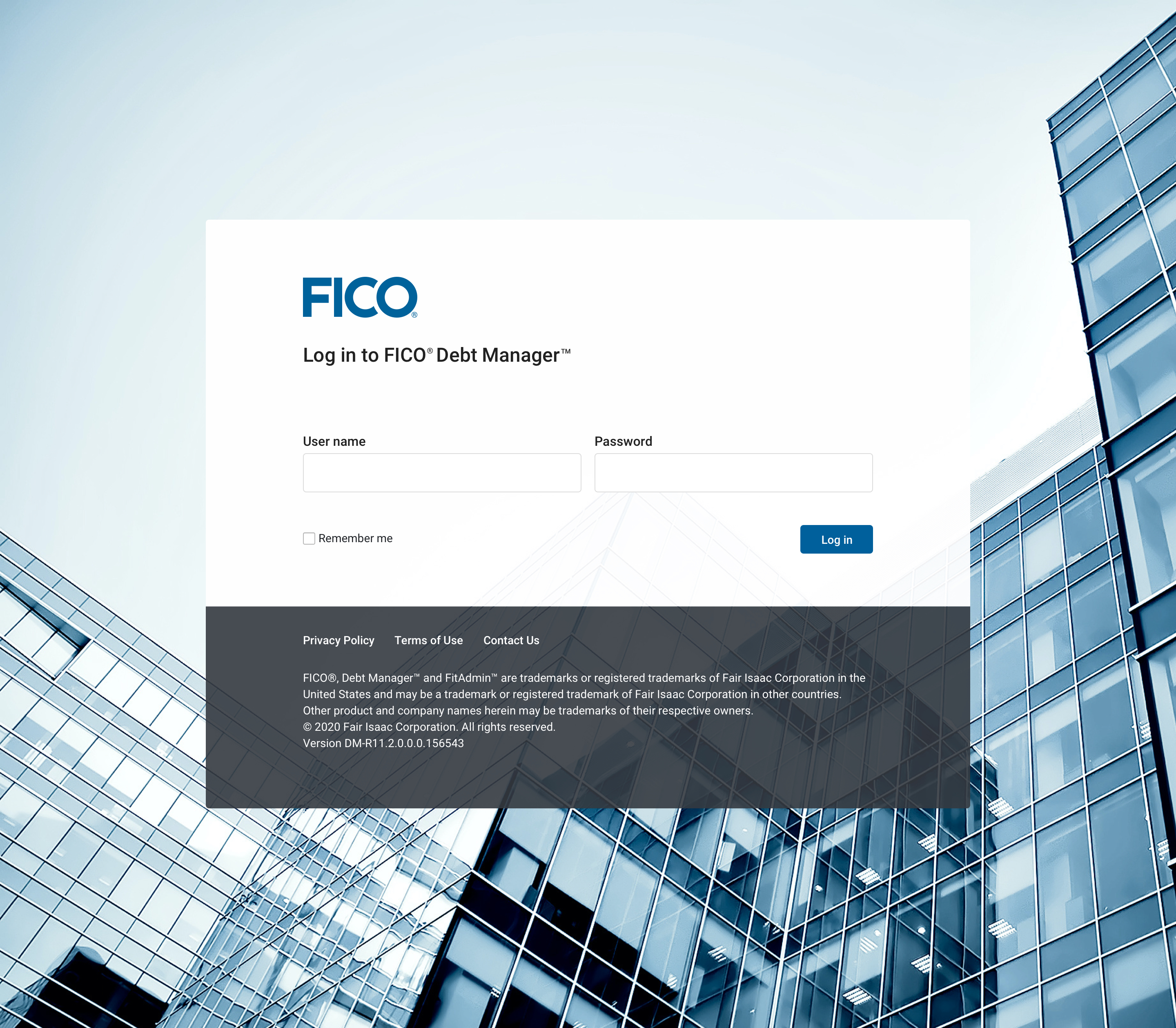
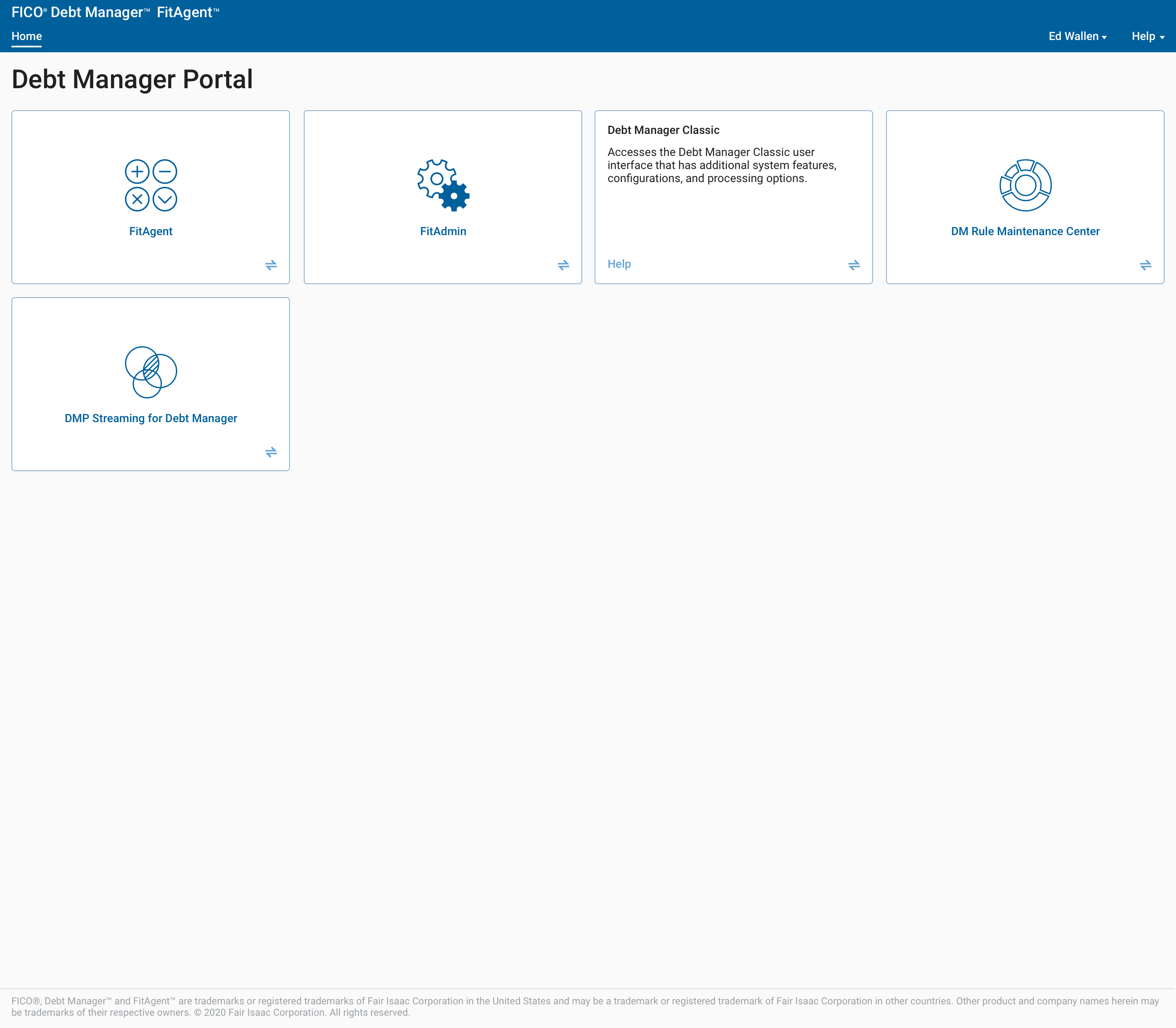
Debt Manager FitAgent — Login screen Debt Manager FitAgent — Portal home

The modernized Debt Manager delivered a cohesive, brand-aligned experience across a complex enterprise feature set — the result of sustained cross-functional work spanning discovery, UI design, design QA, and engineering handoff over four years. The system served collections and debt recovery teams across banking, telecommunications, government, and healthcare sectors.

In 2021, FICO sold its Collection & Recovery business unit to Jonas Software, a subsidiary of Constellation Software — a testament to the maturity and market value the modernized platform had achieved.
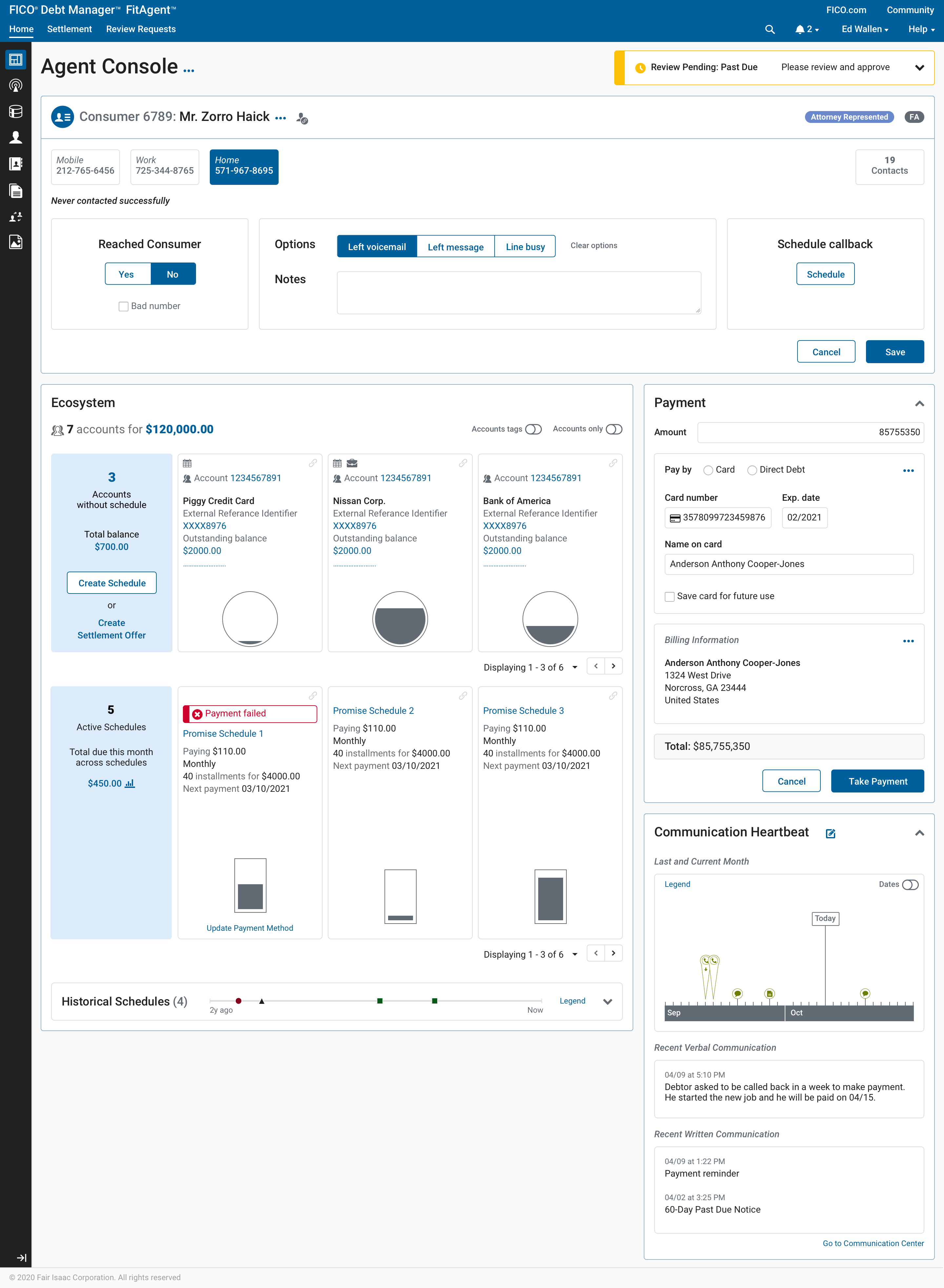
Debt Manager FitAgent — Agent Console